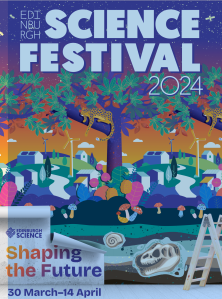
 On Thursday 4th April, I attended a private reception to celebrate the exhibition Creative Informatics: unleashing the power of data. The exhibition was hosted at the National Museum of Scotland as part of the Edinburgh Science Festival 2024 to mark the end of the funded phase of the Creative Informatics (CI) programme. Since its inception in 2018, Edinburgh Napier University has been one of the four partners of the CI programme alongside the University of Edinburgh, Creative Edinburgh and Codebase.
Over the past five years, the programme has supported individuals and organisations in the creative industries in Edinburgh and south east Scotland to innovate with data and digital technologies. (These include the Platform to platform project that I undertook with colleagues at Edinburgh Napier University in 2022 to create the Diary of the war podcast series.)
The exhibition at the National Museum of Scotland featured some of the innovative and creative projects that the programme has funded:
- Ailie Finlay: My kind of book
- Bear Hammer: Venture’s gauntlet
- Caitlin McDonald & Inge Panneels: Picture your poisons


Dr Claire Sowton and Reul-iùil – guiding star (with a mocktail)
- Dominika Jackowska: Interactive light box
- Ice cream at the interval: Reimagining the Empire Palace
- Kate Ive: To the core

Kate Ive and To the core
- Mahsa Nikoufar: Creative gradient
- Mella Shaw: Sounding line
- Playable Technology: Beat blocks live
- Ploterre: Naturally curious
- Ray Interactive: IMP
- Tinderbox: Tinderbox Games club xxpo
- Yaldi Games: Wholesome out and about
Three exhibits were of particular interest to me:
- As a former breast cancer patient, I was fascinated by the intimate representation of the cancer treatment journey in Picture your poisons, especially the depiction of the therapies that I undertook in 2018.
- Cloudquilting is a personalised quilt pattern creator that allows makers to embed meaning in their creations through the use of data-driven design. I enjoyed learning about the software partly because I have made several quilts myself over the years, but mainly because I loved the idea behind generating a very personal artefact using existing data sets. I used to make cloth teddies as presents for friends’ new-born babies in the 1990s. Having seen the Cloudquilting output on display at the exhibition, I am pretty sure that I would have been tempted to make personalised quilts for these children – had the technology been available at the time, of course.
- The third exhibit that fascinated me was To the core. This is a Jesmonite sculpture carved with geometric patterns that reflect data on the decline of native flora and fauna in the UK. Using an app, it is possible to decode the patterns in the sculpture. The sculpture is both a beautiful, tactile piece of art, and a means of prompting actions to support biodiversity in communities.
Also as part of the evening, Professor Melissa Terras (CI Director) and Nicola Osborne (CI Programme Manager) delivered two short speeches about the CI programme.

Professor Melissa Terras and Nicola Osborne deliver their speeches
Amongst the many votes of thanks was a special one for CI founding director Professor Chris Speed. Chris couldn’t be at the event in person because he’s now based at RMIT in Melbourne, Australia. However, the ‘lucky’ shirt that he wore on the day that the team made their bid for project funding at the research council offices in Swindon is still in Edinburgh. The two speakers proudly displayed the precious garment to the audience.

Professor Chris Speed‘s lucky shirt
The speakers also relayed some fascinating statistics on the return of the £10 million investment in the CI programme. These include the generation of 212 new products, services and experiences, 445 new and safeguarded jobs, and gross value added (GVA) of £53.2 million. Congratulations to all on the achievements of the CI programme, and on the hosting of the fascinating exhibition at the Edinburgh Science Festival 2024.

 Hazel Hall