
For a retired person, work-wise March 2025 has been a super-busy month for me. I have:
- Helped edit a draft journal article manuscript
- Provided feedback on documents related to the next Research Excellence Framework in 2029 (REF)
- Prepared and delivered a presentation for archives and records professionals with Dr Bruce Ryan on our work on the Lorna Lloyd archive
- Joined in the reboot of the Edinburgh Coffee Morning
- Attended lectures on a range of topics ranging from radical thinking to dark matter
- Written an award nomination for a former student who has achieved great things since graduating from Edinburgh Napier University in 2009
- Submitted an abstract for a talk to be delivered in May 2025
I had several opportunities to complete a few more other work-related tasks this month. However, conscious of everything else (both work and personal) that needs my attention at the moment, I (sensibly) turned down these invitations.
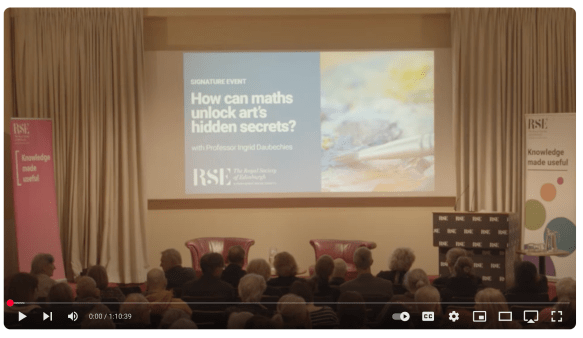
The Royal Society of Edinburgh videoed the talk, available to watch on YouTube
The two work highlights for me occurred in the week beginning 10th March. On the Monday I listened to a fascinating talk at the Royal Society of Edinburgh (RSE) on the application of mathematical techniques in art. Professor Ingrid Daubechies explained how she and her fellow researchers have used wavelets for purposes such as confirming the attribution of pictures, restoring elements of paintings that have suffered damage or partial destruction, and reassembling fragments of destroyed artworks. The speaker focused on three case studies in particular. These were concerned with work: (1) to extend the earlier discovery and ‘cleaning up’ of a hidden portrait of a peasant woman by Van Gogh; (2) to ‘reverse’ the effects of ageing, and ‘correct’ effects of earlier poor conversation work, on the Ghent altarpiece; and (3) to restore Ghissi’s St John altarpiece. The talk was videoed and is available to watch on YouTube. It includes a ‘guest appearance’ from me at 54 minutes when I ask whether the techniques described in the talk have been adopted for use in criminal cases such as prosecutions for art forgery.
My other March highlight was also organised by the RSE on Friday 14th, four days after the talk described above. This was the Society’s triennial dinner, which was held at the National Museum of Scotland. As well as enjoying a lovely meal, I had great company at my table, we were treated to musical entertainment led by Donald Shaw of Capercaillie, and the few speeches were of an appropriate length for a celebratory event. The drinks reception at the start of the evening also provided a great opportunity to catch up with other RSE Fellows, including Professor Jo Shaw who starts her term as the newly-elected RSE General Secretary tomorrow on 1st April 2025.

Professors Jo Shaw and Hazel Hall at the RSE triennial dinner
 Hazel Hall