iConference 2026 Edinburgh highlights

iConference, 2026, banner, Edinburgh, Napier
This year’s iConference was hosted by my former colleagues at Edinburgh Napier University, with on-site sessions for 340 delegates taking place at the University’s Craiglockhart campus between 29th March and 2nd April 2026. I was delighted to join the event to catch up with old colleagues and external work friends, and to learn about new directions in information science research from the next generation of researchers.

The venue with its large, open ground floor area, was perfect for such an event, not least for ease of networking.

networking, conference

Networking on the ground floor of Edinburgh Napier University’s Craiglockhart campus at the 2026 iConference

I am full of admiration for the local organising team, headed by Dr Frances Ryan and Dr Iain McGregor, for undertaking such a huge conference commitment. Their superb organisational skills contributed much to the successful delivery of a great conference.

Dr Frances Ryan, iConference

Dr Frances Ryan opens the 2026  iConference at Edinburgh Napier University

Perhaps because I have been an emeritus professor for the past three and half years, the stand-out session for me was not a paper, panel session, poster or keynote speech, but the conference dinner. Here I sat at one of the beautifully laid tables beside two of the colleagues with whom I have collaborated the most in my career – Dr Bruce Ryan and Dr Peter Cruickshank (also retired) – and with my Finnish friend Professor Isto Huvila.

table, setting, conference, dinner

Table settings for the conference dinner

After the meal, I caught up with the Dean of the School of Engineering, Computing and the Built Environment (SCEBE) Professor Peter Andras, and my former colleague Dr Debbie Meharg. (Debbie, who now works at Aberdeen University, was on the team that put in the initial bid for Napier to host the 2026 iConference.) Then I joined in conversations with Frances Ryan and two colleagues from two other Scottish universities: Professor Ian Ruthven from Strathclyde, and Dr Ian Anderson from Glasgow.

Amongst others, I also chatted with an Iranian PhD student based in British Colombia whose fascinating research is concerned with provenance information displayed alongside Persian artefacts in five major exhibitions held across the world in the twentieth century, and an American colleague who apparently had designs of tempting me out of retirement!

Frances Ryan, Hazel Hall

Dr Frances Ryan and Professor Hazel Hall at the iConference 2026

For me, the other main highlight of the 2026 iConference was an ‘Edinburgh enlightenment and geology’ walking tour. My former colleague Dr David Haynes, who retired from a lecturing post within SCEBE last year, led this part of the conference’s social programme.

Over 90 minutes on the last afternoon of the iConference, David took a group of delegates through central Edinburgh, following a route that included the Lawnmarket, the Mound, Princes Street Gardens, and Calton Hill. We made several stops along the way for David to speak on the theme of Edinburgh as a city of Enlightenment ideas and one created by its geology. David cleverly linked together the themes of philosophy, science and the landscape, often highlighting the work of James Hutton, the father of modern geology. David explained the ways in which Edinburgh in the eighteenth century provided conditions that provoked questions about the age of the world, and encouraged the exchange of ideas amongst key Enlightenment figures such as David Hume and Adam Smith.

At the conclusion of the formal part of the tour, six of us headed into the Edinburgh New Town for tea and biscuits in one of the city’s private gardens.

The slideshow below captures some of the moments in David’s tour.

This slideshow requires JavaScript.

The next iConference in 2027 will be jointly hosted by Victoria University of Wellington and Monash University. The virtual programme will take place from 22nd to 25th March 2027, with the on-site part of the conference taking place on campus at  Victoria University of Wellington from 5th to 9th April 2027. Unfortunately I don’t expect to be travelling all the way to New Zealand for this event. However, I hope that those lucky enough to attend the iConference in 2027 will find it as well worth the journey as those who came to Edinburgh in 2026.

All change for Dr Bruce Ryan

Dr Bruce Ryan

Dr Bruce Ryan

After 13 years at Edinburgh Napier University, Dr Bruce Ryan’s role as Senior Research Fellow has come to an end. Last Friday, I joined Bruce for a special meal to mark his last day in paid employment at the University. Amongst the other guests were our (former) colleagues Dr Peter Cruickshank, Dr David Haynes, and Dr Rachel Salzano.

I worked closely with Bruce for over a decade when we were colleagues in the Centre for Social Informatics. Of the many projects on which we collaborated, three stand out: Continue reading

Marking the 80th anniversary of VE day with a contribution to The Conversation

The Conversation logoToday is the 80th anniversary of VE Day. On this date in 1945, the Second World War allies formally accepted Germany’s unconditional surrender of its armed forces.

Amongst the articles published in The Conversation this week to mark the 80th anniversary is ‘VE Day: how personal first-hand accounts help keep everyday narratives of wartime Britain alive’. This article highlights the value of audio to bring the words of ordinary people from the Second World War directly into the present. The content of the article draws on the analysis of audience engagement with Lorna Lloyd’s Diary of the war in two online formats: (1) text and images on Blipfoto posted from 1st September 2019; (2) an eight episode podcast series that starts with diary entries from early September 1939. The analysis was first presented in an article that I co-authored with Dr Bruce Ryan, Marianne Wilson and Dr Iain McGregor, published in Archives in December 2024. Continue reading

March 2025 work highlights

For a retired person, work-wise March 2025 has been a super-busy month for me. I have:

  • Helped edit a draft journal article manuscript
  • Provided feedback on documents related to the next Research Excellence Framework in 2029 (REF)
  • Prepared and delivered a presentation for archives and records professionals with Dr Bruce Ryan on our work on the Lorna Lloyd archive
  • Joined in the reboot of the Edinburgh Coffee Morning
  • Attended lectures on a range of topics ranging from radical thinking to dark matter
  • Written an award nomination for a former student who has achieved great things since graduating from Edinburgh Napier University in 2009
  • Submitted an abstract for a talk to be delivered in May 2025

Continue reading

A new postcard to publicise the Platform to Platform project

Lorna Lloyd diary war postcardDr Bruce Ryan and I are planning a couple of speaking engagements about our work on Lorna Lloyd and her Diary of the war in the near future, so today we worked on an updated version of our publicity postcard. Above is the front of the version that we are sending to be printed today. If anyone would like a copy when it’s ready, please email me.

‘Podcasting the archive: an evaluation of audience engagement with a narrative non-fiction podcast series’ published

cover image Archives: The Journal of the British Records Association‘Podcasting the archive: An evaluation of audience engagement with a narrative non-fiction podcast series’ is now available in issue 2 of volume 28 of Archives, published last month. I am a co-author of the article alongside Dr Bruce Ryan, Marianne Wilson, and Dr Iain McGregor.

In this work we compare audience engagement with a Second World War archive presented digitally in two formats as: (1) images and text in a Blipfoto journal, and (2) sound in an eight-episode podcast series (which starts with episode 1 here). The main findings reveal differences in levels of engagement for each presentation in respect of entertainment value, learning opportunities, and emotional response. Flexibility of access and authenticity of the archived material were also found to be important to audience engagement, with the nature of contextual information provided alongside the core archive key to the latter. Here we further understanding of facets of audience engagement with digitised archives while opening up new thinking on means of encouraging the general public to interact in more meaningful ways with historical records. Continue reading

Dr Bruce Ryan wins CILIPS funding to explore school librarians’ roles in tackling misinformation and disinformation

Congratulations to Dr Bruce Ryan, Senior Research Fellow in the School of Computing Engineering and the Built Environment at Edinburgh Napier University, on securing funding for a new research project.

The Chartered Institute of Library and Information Professionals Scotland (CILIPS) has funded Bruce to undertake research into the ways that school librarians can help pupils understand the implications of misinformation (i.e. incorrect information that has been created and disseminated by mistake) and disinformation (i.e. false information that has been deliberately created and disseminated with intent to mislead).

Bruce will collect qualitative and quantitative data from school librarians by focus group and in interviews on their: (1) efforts to help pupils in navigating challenging information landscapes and handling misinformation and disinformation; (2) training needs in fulfilling this role; and (3) collaborative work with teachers to address pupils’ understanding of misinformation and disinformation. Continue reading

Article accepted by ‘Archives’ on audience engagement with podcast series

platform, logo, Lorna, Lloyd, war, diary‘Podcasting the archive: an evaluation of audience engagement with a narrative non-fiction podcast series’ has been accepted for publication by Archives journal in October 2024. This contribution is the main output of the AHRC-Creative Informatics funded Platform to platform project. It is co-authored by Dr Bruce Ryan, Professor Hazel Hall, Marianne Wilson, and Dr Iain McGregor. Continue reading
Work over winter 2023/24

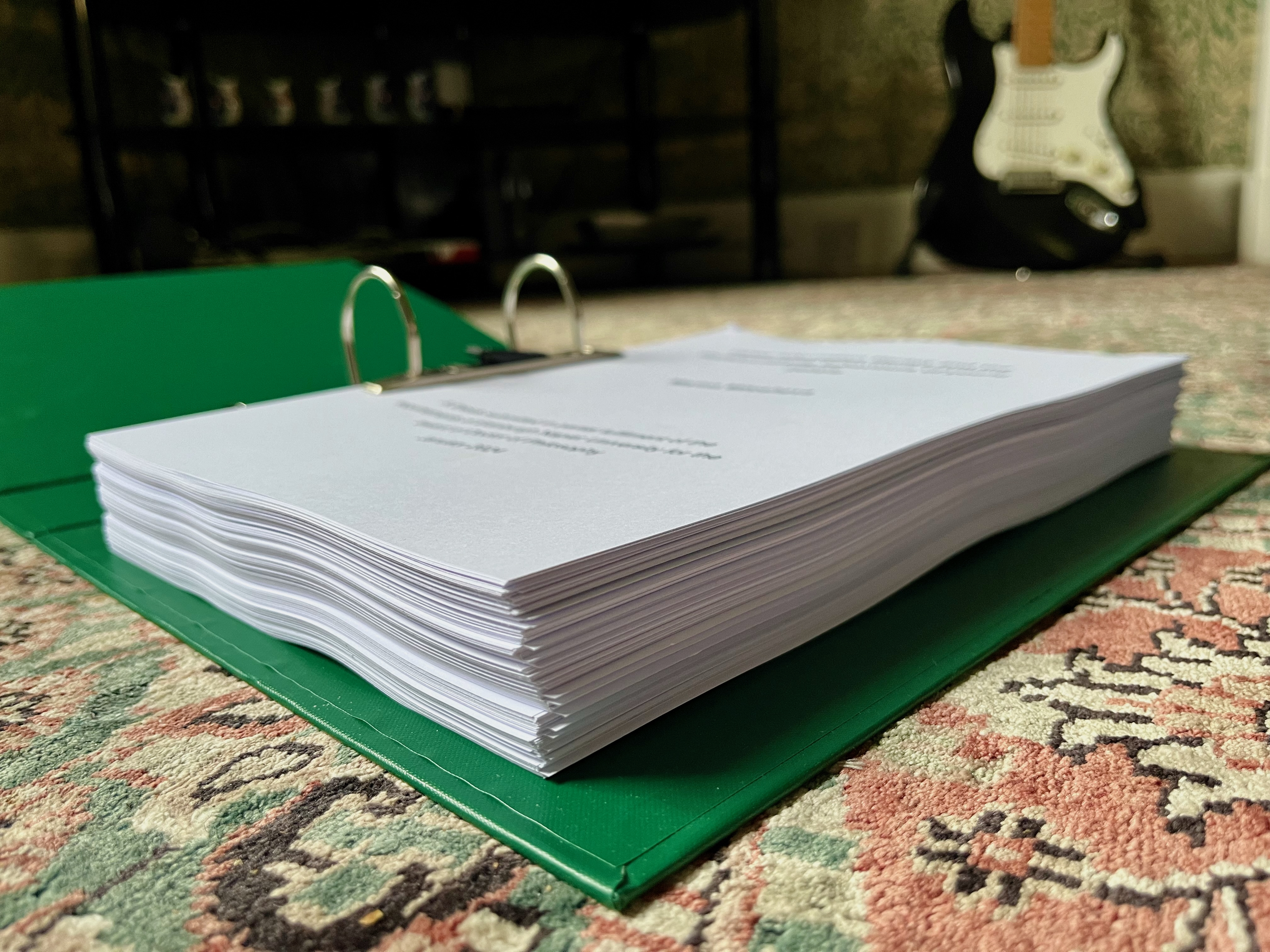
Marina Milosheva draft PhD thesis

Marina Milosheva’s draft PhD thesis

I have been a little quiet on this blog over the past five months or so. The main reason for this is that I have taken on a further role in addition to that of Emeritus Professor. I am now Continue reading

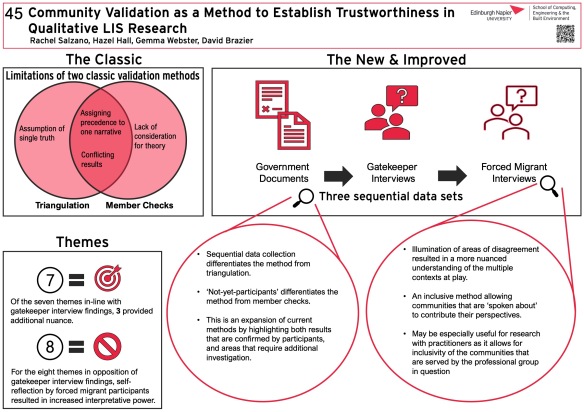
Community validation in qualitative research: contribution to #asist23

ASIST 2023 poster Salzano Hall Webster Brazier

Poster by Edinburgh Napier Social Informatics Research Group colleagues presented at #ASIST23

The main programme of the 2023 Annual Meeting of the Association for Information Science and Technology opens today in London. Sadly I cannot be there in person with my (lucky) Edinburgh Napier University Social Informatics Research Group colleagues*. Continue reading