 Today is the 80th anniversary of VE Day. On this date in 1945, the Second World War allies formally accepted Germany’s unconditional surrender of its armed forces.
Amongst the articles published in The Conversation this week to mark the 80th anniversary is ‘VE Day: how personal first-hand accounts help keep everyday narratives of wartime Britain alive’. This article highlights the value of audio to bring the words of ordinary people from the Second World War directly into the present. The content of the article draws on the analysis of audience engagement with Lorna Lloyd’s Diary of the war in two online formats: (1) text and images on Blipfoto posted from 1st September 2019; (2) an eight episode podcast series that starts with diary entries from early September 1939. The analysis was first presented in an article that I co-authored with Dr Bruce Ryan, Marianne Wilson and Dr Iain McGregor, published in Archives in December 2024.
One of the main findings from the full write-up of research is that people today can forge strong emotional connections to the past, and gain a real appreciation of living through the war in Britain, when they listen to (rather than read) the words of a civilian writing about the conflict as it unfolds. Accessing archive material in this way also prompts consideration of parallels between past and current hostilities. In this case, the study participants were quick to draw comparisons between (1) Germany and Russia and (2) Hitler and Putin, for example when thinking about the way that civilians are displaced during conflicts.
Cited in the article in The Conversation are some of the passages from Lorna Lloyd’s war diary entries, including this from 3rd June 1940:
There are times when I feel endlessly old, and worn out, and others when I feel hopelessly young, and completely unable to combat life, or to hope for any future. I know somehow, despite the frantic entry of May 15th, that we shall win in the end, but my spirit quails at the task of building up again what has been broken down. It took 22 years to arrive even in this country at anything like normality after the last war. When things have settled down again shall I be old?
The irony of this commentary is that Lorna never grew old. When the end of war in Europe came five years later on 8th May 1945, she had already been dead for over three years.
For further information about Lorna Lloyd and the research associated with her war diary, please see the Lorna Lloyd page on this site.
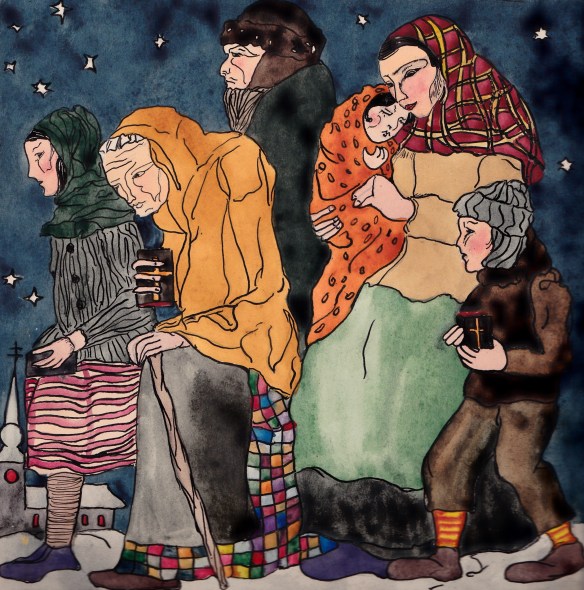
Lorna Lloyd was also a talented artist, as shown in this watercolour depicting refugees
 Hazel Hall