
Girton College, University of Cambridge
When I first started posting entries from the Diary of the war to a Blipfoto journal in September 2019, I knew very little about its author Lorna Lloyd. I was, however, aware that she had been a student Girton College Cambridge in the 1930s. I was therefore hopeful that the College archives might hold materials related to Lorna’s time as an undergraduate student. My plan was to use these to flesh out the few details that we knew about Lorna at that time.
The day after I contacted the archives, I received some very useful information about Lorna, plus an invitation to visit the archive in person to see the original records for myself. I replied enthusiastically with thanks, and with plans to visit Cambridge as soon as I could. Due to other commitments, I guessed that this would probably not be until early 2020. Of course, we were not to know then that six months later, very few people would be travelling anywhere at all.
I finally made it to Girton on 21st August 2024, four and a half years later than anticipated. In the interim: Lorna had become something of a celebrity on Blipfoto; a podcast series of the Diary of the war had been produced and launched; the podcast series had been recognised in a national competition; and members of the team behind the podcast series had written up for publication their research on audience engagement with online archives.
My visit to Cambridge was very successful, not least because the archives staff had prepared a room for me so that I could examine the relevant records that they had already extracted from the collection. There I found:
- GCAS 2/3/1/65: Lorna’s roll file
- GCAC 2/4/1/9: Lorna’s tutorial file
- GCPH 10/9/20: the 1933 first year photograph
- GCPP 2/1/2&3: copies of the Girton Review for the years that Lorna was a student
Some of the items were handwritten, such as Lorna’s application form for admission to the College, which she completed in October 1932. Anyone familiar with the Diary of the war in the LornaL Blipfoto journal will instantly recognise Lorna’s handwriting on this document.
Other documents were typed, including two references – one by her school headmistress Dorothy L. Walker to support her application to Girton, and the other by the Mistress of Girton Helen Wodehouse (cousin of PG) just before she left – and a summary of her educational record.
The remainder of written records are from printed materials in the Girton Review and the College’s Annual report. The majority of these relate to Lorna’s participation in the production of dramatic performances at the College.
Much of the information contained within these documents confirms aspects of Lorna’s life with which we are already familiar. For example: she applied to Girton in autumn 1932; prior to this she had studied at Ilford Hall High School for three years and then Sheffield High School for eight; she could read and speak French; she was a member of the college debating society; and she was very creative.
It is interesting now to be able to tie the details of the dramatic performances in which Lorna was involved at Girton with images already posted to the LornaL Blipfoto journal. For example, the costume designs for which she was congratulated in the review of Dido and Aeneas in the Easter 1936 issue of the Girton Review (see above) feature in Blipfoto journal entries between 16th July 2020 and 30th July 2020. Similarly, although the reference for Lorna written by her school headmistress Dorothy L Walker in 1932 doesn’t tell us anything new, her way of expressing her opinion of her pupil’s talent for English is amusing: ‘her English work, though not really exceptional, is very good’. Walker’s reference to Lorna’s family background reads to us as old fashioned, and not a judgement that we would expect to see in an educational reference today: ‘She comes from a pleasant and cultured home’.
There are some snippets of information in the archive that offer new insight on Lorna, for example, that she held a qualification in chemistry, that she made hats (as well as clothes), and that she was secretary of the College art club. Perhaps the most interesting – and saddest – detail in the archive is found in a letter from an Assistant Tutor to Lorna’s mother Alice ‘Topsie’ Lloyd in January 1935. This refers to a period of ill health for Lorna.
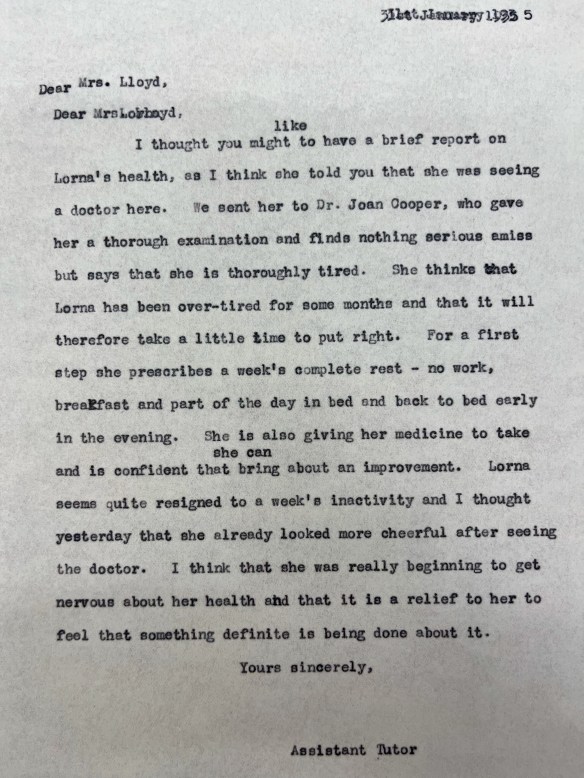
A letter from an Assistant Tutor to Lorna’s mother Alice ‘Topsie’ Lloyd in 1935
At the time, Topsie would have been relieved to hear that the doctor found ‘nothing serious amiss’ and concluded that her daughter was merely overtired. However, we know from the Blipfoto journal that Lorna was under medical supervision during the period in which she wrote her war diary, and died on 2nd February 1942 (almost exactly seven years after this letter was typed). The contents of this letter indicate that Lorna was exhibiting symptoms of her final illness as early as 1934. (It is also striking that the majority of death notices in the Easter 1942 issue of the Girton Review are for former students who left Cambridge in the 1800s.)
I was surprised that Girton holds just one photograph of Lorna. She is the back row of the shot of the new student intake in autumn 1933. Here is a group of talented young women full of hope for their undergraduate studies and the years ahead. Unfortunately for Lorna, she died within a decade of the picture being taken.

Lorna with others who joined Girton in 1933, including Daphne Bird, whose music thesis is referenced in the letter that Lorna’s brother wrote to their father at the time of Lorna’s death
 Hazel Hall