

Shakespeare’s pub on Lothian Road was transformed into the Napier Graduate last week
Congratulations to Dr Marina Milosheva, whose doctoral degree was conferred in absentia at the Edinburgh Napier graduation ceremony at the Usher Hall in Edinburgh last Friday 5th July. Although Marina did not attend the ceremony in person, this day was a significant milestone in her PhD journey. This is because it is only from the date of the graduation ceremony that new PhD graduates are permitted to place the term ‘Dr’ before their names.
I supervised Marina’s doctoral work alongside Dr Peter Cruickshank and Professor Pete Robertson. Marina embarked on the PhD element of her 1+3 ESRC/Skills Development Scotland funded studentship in October 2020 when we were all living restricted lives due to the coronavirus pandemic. This means that her experience as a doctoral student was quite unusual. For example, the majority of our supervision meetings took place online, Marina was forced to develop a remote data collection strategy, and Marina missed out on opportunities to travel to conferences to present her on-going work and network with fellow researchers.
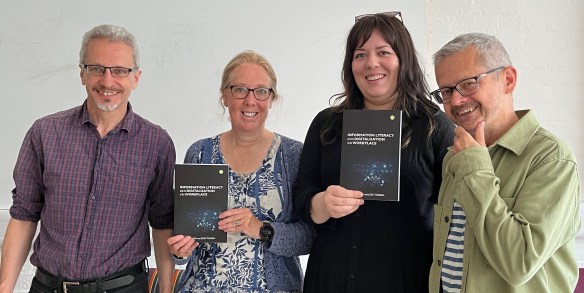
Marina Milosheva and her supervision team. L to R: Professor Pete Robertson, Professor Hazel Hall, Dr Marina Milosheva, and Dr Peter Cruickshank
Despite all the practical challenges that Marina faced in undertaking doctoral research during a pandemic, she achieved the rare outcome at her viva of ‘Unconditional pass’, i.e. no corrections to her thesis were required.
Her completed work, entitled Career information literacy and the decision-making behaviours of young people, presents the first detailed account of young people’s information behaviour and use in the specific context of career decision-making, making three contributions to theory.
- It articulates career information seeking as a two-stage process. Within this, the practice of socially-mediated information seeking with trusted, accessible contacts – including those who ‘prompt’ information seeking – plays an important role.
- It uncovers resilience as an information literacy skill.
- It identifies two distinct career decision-making styles: (1) fulfilment based; (2) pragmatic.
These contributions to theory are captured in a hybrid conceptual framework that surfaces the roles of information in the career decision-making process. A further contribution of the doctoral research comprises a set of five recommendations for the development of policy and practice to support the provision of careers services in Scotland. The everyday life focus of the work, in which young people’s processes of information seeking and decision making are considered as sense-making, yields both conceptual value for library and information science research, and practical value for career guidance practice.
The thesis itself will soon be available from the Edinburgh Napier Repository. In the meantime, several contributions from Marina‘s doctoral research published in international peer-reviewed journals and conferences are available for download:
- Milosheva, M., Robertson, P., Cruickshank, P. & Hall,. H. (2024). The collaborative use of career information by young people and career advisers: a thematic content analysis of career counselling records. Australian Journal of Career Development 33(1), 72-81. [Full text available from the publisher; full text available from the Edinburgh Napier repository.]
- Milosheva, M., Hall, H., Robertson, P. & Cruickshank, P. (2022). Capturing career information use in everyday life: introducing the CIEL conceptual framework. Information Research 27 (October 2022 special issue). [Full text freely available from the publisher; full text available from the Edinburgh Napier repository.]
- Milosheva, M., Hall, H. & Robertson, P. & Cruickshank, P. (2022). New information literacy horizons: making the case for career information literacy. In Information literacy in a post-truth era: 7th European Conference, ECIL 2021 (online), September 20–23, 2021, revised selected papers (pp. 239-252). Springer. [Full text available from publisher with subscription access; full text available from the Edinburgh Napier repository.]
- Milosheva, M., Hall, H. & Robertson, P. & Cruickshank, P. (2022). A sequential explanatory methodology for the study of young people’s career information literacy and career information behaviours. Poster presented at the iConference 2022 (virtual conference), 28 February – 4 March 2022. [Full text available from the Edinburgh Napier repository; poster available from the Edinburgh Napier repository.]
- Milosheva, M., Robertson, P., Cruickshank, P. & Hall, H. (2021). The role of information in career development. Journal of the Institute for Career Education and Counselling, 47(1), 12-20. [Full text available from publisher with subscription access; full text available from the Edinburgh Napier repository.]
- Milosheva, M., Hall, H. & Robertson, P. & Cruickshank, P. (2021). New information literacy horizons: making the case for career information literacy. Paper presented at the European Conference on Information Literacy ECIL 2021 (virtual conference), 20-23 September 2021. [Abstract available from the Edinburgh Napier repository.]
Last year Marina and her supervision team also contributed a chapter to a book on workplace information literacy:
- Milosheva, M., Hall, H., Robertson, P. & Cruickshank, P. (2023). Information literacy competencies for career transitions in the digital age. In G. Widén & J. Teixeira (Eds.), Information literacy and the digitalization of the workplace (pp. 71-100). London: Facet. [Full text available from the Edinburgh Napier repository.]
Alongside studying for her PhD, Marina worked as a research assistant on several projects with other colleagues from the Social Informatics Research Group in her period of registration. These resulted in further outputs on the topics of information literacy, information needs analysis, research adaptations due to pandemic restrictions (related to an SGSSS summer school event that she co-hosted with Thoko Kachale in 2021), and a contribution to a podcast series on career information. In addition, Marina published two articles in The Conversation: one on means of escaping from an unfulfilling job, and another on how to network online, and joined me in presenting a training event on the value to academics of creating a personal professional web presence.
Part-way through her studies in 2022 Marina took a break to complete a 13-week internship at the Scottish Government. The work that she undertook in this period led to the publication of an official Scottish Government report.
Marina is now employed as a post-doctoral researcher within the Faculty of Social Sciences (Sociology, Social Policy and Criminology division) at the University of Stirling, as reported on this blog on 1st May 2024. Here her office door displays her new status as a newly-minted PhD graduate.
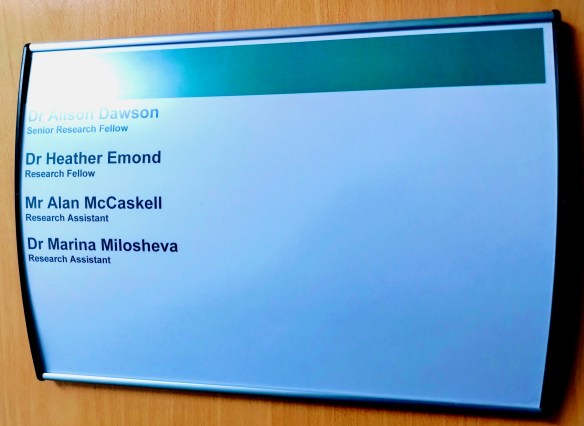
Dr Milosheva’s ‘new’ name on her office door at the University of Stirling
 Hazel Hall