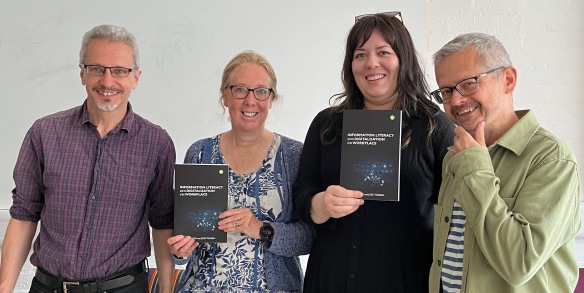
Information literacy and the digitalisation of the workplace has recently been published by Facet. I picked up my copy of the book this morning when I was on campus for a meeting with my fellow co-authors of Chapter 6: Marina Milosheva, Pete Robertson, and Peter Cruickshank (pictured above). Continue reading
Tag Archives: book
Information literacy and the digitalization of the workplace: new book to be published on 13th April 2023
Along with my co-authors Marina Milosheva, Pete Robertson, and Peter Cruickshank, I am excited to see that the details of Information literacy and the digitalization of the workplace are now available in Facet’s publishing catalogue.
The anticipated publication of the book next month on 13th April comes just over two years since its first editor Gunilla Widén (Åbo Akademi University, Finland) initially approached me about the possibility of contributing to this new work. The conversation ultimately led to the preparation of a chapter that draws primarily on some of the research that PhD student Marina Milosheva has undertaken for her ESRC/Skills Development Scotland funded doctoral study on career information literacy and career decision-making, and team discussions in Marina’s supervision meetings. In it we focus on the importance of employability information literacy and career information literacy to sustainable employment in largely digitised work environments. Continue reading
The Circle by Dave Eggers: book review
Over Easter I read The Circle by Dave Eggers. I wouldn’t normally blog about my recreational reading, but there is such a strong overlap between the themes of the novel and my research and teaching interests that I have decided to post my review here.

The tale’s main setting is the Silicon Valley campus of a tech company in the not too distant future. The Circle has already gobbled up several other familiar enterprises and, as such, may be conceived as a fictional amalgamation of companies such as Google, Facebook, Amazon, and Twitter. Its earnest workforce is involved in numerous innovative projects to make the world a “better” place where communities are safe, and a genuine democracy works for the good of all. Circle technologists work on a bewilderingly wide range of innovations that include, for example, systems to eradicate criminal dangers such as child abduction and to guard against political corruption.