
iConference 2026 Edinburgh highlights

iConference, 2026, banner, Edinburgh, Napier
This year’s iConference was hosted by my former colleagues at Edinburgh Napier University, with on-site sessions for 340 delegates taking place at the University’s Craiglockhart campus between 29th March and 2nd April 2026. I was delighted to join the event to catch up with old colleagues and external work friends, and to learn about new directions in information science research from the next generation of researchers.

The venue with its large, open ground floor area, was perfect for such an event, not least for ease of networking.

networking, conference

Networking on the ground floor of Edinburgh Napier University’s Craiglockhart campus at the 2026 iConference

I am full of admiration for the local organising team, headed by Dr Frances Ryan and Dr Iain McGregor, for undertaking such a huge conference commitment. Their superb organisational skills contributed much to the successful delivery of a great conference.

Dr Frances Ryan, iConference

Dr Frances Ryan opens the 2026  iConference at Edinburgh Napier University

Perhaps because I have been an emeritus professor for the past three and half years, the stand-out session for me was not a paper, panel session, poster or keynote speech, but the conference dinner. Here I sat at one of the beautifully laid tables beside two of the colleagues with whom I have collaborated the most in my career – Dr Bruce Ryan and Dr Peter Cruickshank (also retired) – and with my Finnish friend Professor Isto Huvila.

table, setting, conference, dinner

Table settings for the conference dinner

After the meal, I caught up with the Dean of the School of Engineering, Computing and the Built Environment (SCEBE) Professor Peter Andras, and my former colleague Dr Debbie Meharg. (Debbie, who now works at Aberdeen University, was on the team that put in the initial bid for Napier to host the 2026 iConference.) Then I joined in conversations with Frances Ryan and two colleagues from two other Scottish universities: Professor Ian Ruthven from Strathclyde, and Dr Ian Anderson from Glasgow.

Amongst others, I also chatted with an Iranian PhD student based in British Colombia whose fascinating research is concerned with provenance information displayed alongside Persian artefacts in five major exhibitions held across the world in the twentieth century, and an American colleague who apparently had designs of tempting me out of retirement!

Frances Ryan, Hazel Hall

Dr Frances Ryan and Professor Hazel Hall at the iConference 2026

For me, the other main highlight of the 2026 iConference was an ‘Edinburgh enlightenment and geology’ walking tour. My former colleague Dr David Haynes, who retired from a lecturing post within SCEBE last year, led this part of the conference’s social programme.

Over 90 minutes on the last afternoon of the iConference, David took a group of delegates through central Edinburgh, following a route that included the Lawnmarket, the Mound, Princes Street Gardens, and Calton Hill. We made several stops along the way for David to speak on the theme of Edinburgh as a city of Enlightenment ideas and one created by its geology. David cleverly linked together the themes of philosophy, science and the landscape, often highlighting the work of James Hutton, the father of modern geology. David explained the ways in which Edinburgh in the eighteenth century provided conditions that provoked questions about the age of the world, and encouraged the exchange of ideas amongst key Enlightenment figures such as David Hume and Adam Smith.

At the conclusion of the formal part of the tour, six of us headed into the Edinburgh New Town for tea and biscuits in one of the city’s private gardens.

The slideshow below captures some of the moments in David’s tour.

This slideshow requires JavaScript.

The next iConference in 2027 will be jointly hosted by Victoria University of Wellington and Monash University. The virtual programme will take place from 22nd to 25th March 2027, with the on-site part of the conference taking place on campus at  Victoria University of Wellington from 5th to 9th April 2027. Unfortunately I don’t expect to be travelling all the way to New Zealand for this event. However, I hope that those lucky enough to attend the iConference in 2027 will find it as well worth the journey as those who came to Edinburgh in 2026.

A decade of Dangerous Women: celebrating International Women’s Day 2026

A Decade of Dangerous WomenMarch 8th 2026 marks a decade since staff in the Institute for Advanced Studies in the Humanities (IASH) at the University of Edinburgh posted the first entry to the Dangerous Women Project web site on International Women’s Day 2016. In the year that followed, over 350 provocation pieces were added to the site in a bid to answer the question What does it mean to be a ‘dangerous woman’? Continue reading

All change for Dr Bruce Ryan

Dr Bruce Ryan

Dr Bruce Ryan

After 13 years at Edinburgh Napier University, Dr Bruce Ryan’s role as Senior Research Fellow has come to an end. Last Friday, I joined Bruce for a special meal to mark his last day in paid employment at the University. Amongst the other guests were our (former) colleagues Dr Peter Cruickshank, Dr David Haynes, and Dr Rachel Salzano.

I worked closely with Bruce for over a decade when we were colleagues in the Centre for Social Informatics. Of the many projects on which we collaborated, three stand out: Continue reading

What can you do with a PhD? Ten answers from graduates who completed their doctoral studies between 2015 and 2023

One of the questions most often asked of doctoral students is What are you going to do when you finish your PhD? For some students it is also one of the most dreaded, especially when it comes from family members or friends who barely understand the title of the doctoral research in question. An obvious, and truthful, answer is ‘No longer work on my thesis’. However, this isn’t really a suitable response. The questioner is interested in hearing about ‘proper’ job ambitions, and the value of these to a successful future career. Continue reading

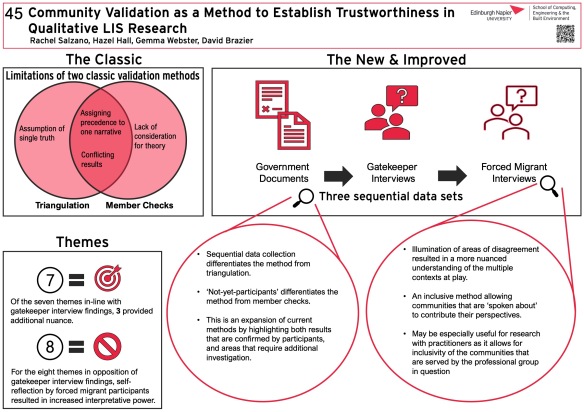
Community validation in qualitative research: contribution to #asist23

ASIST 2023 poster Salzano Hall Webster Brazier

Poster by Edinburgh Napier Social Informatics Research Group colleagues presented at #ASIST23

The main programme of the 2023 Annual Meeting of the Association for Information Science and Technology opens today in London. Sadly I cannot be there in person with my (lucky) Edinburgh Napier University Social Informatics Research Group colleagues*. Continue reading

An afternoon of Social Informatics lightning talks

Hazel Hall, Brian Detlor

Professors Brian Detlor & Hazel Hall

Dr Brian Detlor, Visiting Professor to the Social Informatics Research Group at Edinburgh Napier University, has been in the Edinburgh for the past week. Last Friday I was pleased to participate in one of the events organised to mark Brian’s visit: a lightening talk showcase of some the excellent research undertaken by researchers in the Social Informatics Research Group.

My own presentation was about the AHRC/Creative Informatics funded Platform to Platform project that I completed last year with Dr Bruce Ryan (PI) and Dr Iain McGregor (Co-I). This work involved the creation of a podcast series based on Lorna Lloyd’s Diary of the war, and an assessment audience engagement with archives in two different digital formats – (1) a Blipfoto journal of text and images, and (2) sound in podcast episodes. The slides for my presentation are available on SlideShare. Continue reading

New roles for Social Informatics PhD graduates Buunk, Middleton, Mowbray, and Ryan

What can you do with a PhD from the Centre for Social Informatics at Edinburgh Napier University? Find out here with news of four former PhD students who graduated between 2018 and 2020. Continue reading

Centre for Social Informatics ‘all centre’ meeting June 2022

Social Informatics Research Group Edinburgh Napier University selfie

Dr Peter Cruickshank, Dr David Brazier, Dr David Haynes, Dr Hazel Hall, Katherine Stephen, Dr Bruce Ryan, and Dr JP Vargheese pose for a post-meeting selfie

For the first time since 18th December 2019, this week members of my research group gathered for an end of year ‘all centre’ meeting to celebrate our recent research highlights.

Although not everyone could make it on this occasion, those who could enjoyed spending the afternoon of Wednesday 22nd June together. We took it in turns to deliver short personal updates to the rest of the group on our own research. We also read out details sent to us by email from those who could not participate in person, and gave each absent colleague a round of applause. Continue reading

Applications open for 10 fully-funded PhD studentship places within the School of Computing, Edinburgh Napier University

PhD supervisors Dr Frances Ryan, Dr David Haynes, Debbie Meharg, Dr David Brazier

PhD supervisors from the Centre for Social Informatics

The School of Computing at Edinburgh Napier University is currently advertising ten fully-funded PhD studentships across a wide range of subjects, from sound technologies to cybersecurity. Amongst these are four proposed by Centre for Social Informatics colleagues: Continue reading

Discussing dangerous women on International Women’s Day

Dangerous women project bookThis evening, on International Women’s Day 2022, I will be attending the online book launch of Dangerous women. Edited by Jo Shaw, Ben Fletcher-Watson and Abrisham Ahmadzadeh, the book comprises fifty essays on social and political structures, everyday life, attitudes, and identity to question what it means for a woman to be considered ‘dangerous’, as well the danger that a woman may present to others. I am looking forward to listening to the speakers at the launch. They include Mab Jones, Sujana Crawford, Laura Waddell, Glynis Ridley, and Rachel McCrum.

The perspectives in the book are drawn from a larger body of contributions to the Dangerous Women Project, which ran between International Women’s Day 2016 (I blogged a review of the launch event) and 2017. Continue reading