Centre for Social Informatics contributions to Information Seeking in Context 2020 #isic2020

ISIC 2020 banner logo

Hosted by the Department of Information Science at the University of Pretoria, Information Seeking in Context 2020 (#isic2020) takes place as a virtual conference between 28th September and 2nd October 2020. As has been the case in the past (e.g. 2018 in Kraków, Poland, 2016 in Zadar, Croatia), colleagues from the Centre for Social Informatics at Edinburgh Napier University are looking forward to the opportunity of presenting some of their research at the ISIC conference. Continue reading
Paper accepted for #ASIST2020 on the development of a network for LIS researchers and practitioners in Scotland

ASIST2020 logoMy Centre for Social Informatics colleague Dr Bruce Ryan and I are delighted that our short paper ‘Research Impact Value and Library and Information Science (RIVAL): development, implementation and outcomes of a Scottish network for LIS researchers and practitioners‘ has been accepted for presentation at the (virtual) 83rd Annual Meeting of the Association for Information Science and Technology (ASIST2020). We are grateful to our Centre for Social Informatics Visiting Professor Brian Detlor for providing internal peer review feedback on an early draft of our paper, especially since the acceptance rate for short papers at the conference this year was just 48% this year. Continue reading

A new role for Iris Buunk at LIBER

Iris Buunk

Iris Buunk

Congratulations to (almost Dr) Iris Buunk on her appointment as a Community Engagement and Communications Officer at the Ligue des bibliothèques Européennes de Recherche/Association of European Research Libraries (LIBER). This good news comes within days of Iris’ submission of the corrected version of her PhD thesis, which was examined at the end of March this year.

LIBER was founded in the Hague in 1971 to help university, national and special libraries support world-class research. It is a partner organisation in many European projects that promote open science. The main focus of Iris‘ new role at LIBER is responsibility for activities related to European projects and general LIBER communications. Continue reading

Activity Theory to explore transitioning to agile methods: contribution to #XP2020

The 21st International Conference on Agile Software Development XP2020 takes place this week between Monday 8th and Friday 12th June. Normally delegates would be gathering in Copenhagen to participate in the event. Like many conferences this year, however, the conference has switched to a virtual format.

Amongst the work to be presented at the conference is a paper by Centre for Social Informatics colleagues Pritam Chita, Peter Cruickshank and Dr Colin Smith, with Dr Kendall Richards of Edinburgh Napier University’s Centre for Computing Education Research. Continue reading

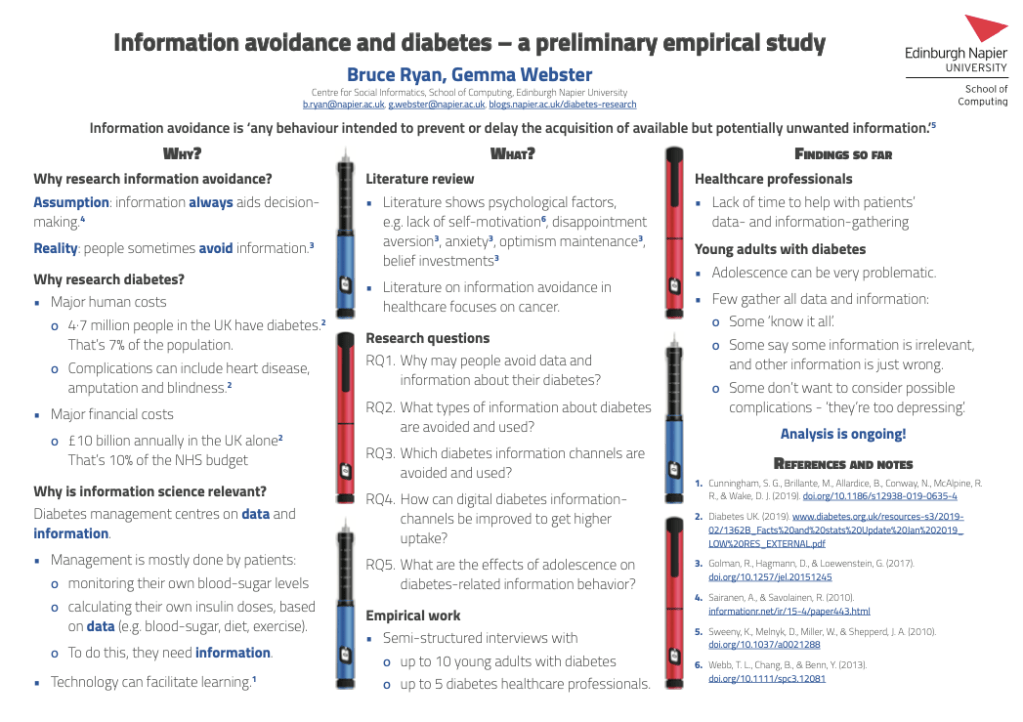
Bruce Ryan and Gemma Webster present on information avoidance and diabetes at Information Science Trends: Health Information Behavior

Next week on Monday 8th June Centre for Social Informatics colleagues Dr Bruce Ryan and Dr Gemma Webster are presenting a poster at Information Science Trends: Health Information Behavior. This free virtual event takes place over 3 days between 8th and 10th June in three 3-hour sessions. It has been organised by the European Chapter of the Association for Information Science and Technology (ASIST). Continue reading

Rachel Salzano contributes to the work of the Alan Turing Institute

Rachel Salzano

Rachel Salzano

The Alan Turing Institute is the UK’s national institute for data science and artificial intelligence. It was established in 2015 with headquarters at the British Library in London. The work of the Institute is achieved through collaborations between universities, businesses, and public and third sector organisations to address some of the biggest challenges in science, society and the economy.

Currently Rachel Salzano, a PhD student within the Centre for Social Informatics at Edinburgh Napier University, is contributing to the institute’s research on detecting and understanding harmful content online. She has been employed by the Institute in two roles. Continue reading

Hyperlocal democracy, tacit knowledge sharing, digital youth participation, and online reputation building and management: four more papers in JoLIS

Journal of Librarianship and Information ScienceThe last four articles of the seven that I developed with Centre for Social Informatics colleagues from the conference papers that we presented at i3 in 2017 have worked their way through the publication process, and can now be found in the print form with assigned volume, issue and page numbers in the Journal of Librarianship and Information Science. The article titles and themes are: Continue reading

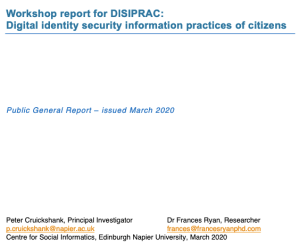
Digital identity security information practices of citizens (DISIPRAC) report now available

DISIPRAC reportDigital identity security information practices of citizens (DISIPRAC) is a project led by Peter Cruickshank.

On Thursday 27th February, Peter and our (then) Centre for Social Informatics colleague Dr Frances Ryan (now at Aberdeen University) hosted a workshop on the DISIPRAC project themes. This took place at the Edinburgh Napier University Merchiston campus. Twelve people, all of whom help adults in the community, joined Peter and Frances to discuss three scenarios associated with facilitating access to services provided by UK, Scottish, and local governments. Continue reading

A new role at the UN for Dr Alicja Pawluczuk

Congratulations to our PhD graduate Dr Alicja Pawluczuk who today (1st April 2020) starts a new work role as Young Information and Communication Technologies and Development Fellow at the United Nations University Institute in Macau.

Over the next twelve months, Alicja will be examining current approaches to digital inclusion measurement, and investigating digital inclusion practitioners’ narratives of their experience of digital inclusion measurement. The objective of Alicja’s fellowship is to analyse the state-of-the-art of digital inclusion measurement and evaluation on the basis of a systematic literature review. It is anticipated that outcomes of this research will inform UN policy-making on issues related to ICTs and sustainable development. Continue reading