A decade of Dangerous Women: celebrating International Women’s Day 2026

A Decade of Dangerous WomenMarch 8th 2026 marks a decade since staff in the Institute for Advanced Studies in the Humanities (IASH) at the University of Edinburgh posted the first entry to the Dangerous Women Project web site on International Women’s Day 2016. In the year that followed, over 350 provocation pieces were added to the site in a bid to answer the question What does it mean to be a ‘dangerous woman’?

Amongst these contributions was my own on environmental scientist and Scottish aid worker Dr Linda Norgrove, who was kidnapped by the Taliban in Afghanistan on 26th September 2010 and died just a few days later in a failed rescue attempt on 8th October 2010. I also helped Dr Frances Ryan – one of my PhD students at the time, now a lecturer at Edinburgh Napier University – write for the project on dangerous young widows.

Since its official end in March 2017, the Dangerous Women Project has enjoyed a busy afterlife, for example in the publication of three books: (1) The art of being dangerous: exploring women and danger through creative expression, (2) Dangerous women: fifty reflections on women, power and identity and Women who dared: from the infamous to the forgotten. The project’s enduring relevance is also evident in its use as a teaching resource.

Given my on-going interest in the project, I was delighted to attend a lunchtime seminar entitled A decade of dangerous women at IASH last Friday 6th March 2026. Here, following an enthusiastic introduction by Professor Jo Shaw, a new cohort of researchers delivered seven minute presentations on dangerous women from the past and present. The speakers and their topics were:

  • Dr Elsie C. Albis on (predominantly female) Filipino shamans known as balinana or babaylan. Regarded by their communities as healers, leaders, keepers of memory, visionaries, and priestesses, they terrified Spanish colonialists.
  • Dr Kate Ash-Irisarri on Isabel, Countess of Buchan (C14th-C15th), whose role in the Wars of Scottish Independence has often been recast as a medieval sex scandal centred on a lustful woman, or otherwise ignored/eradicated in the record.
  • Dr Anna Girling on Nancy Cunard (1896-1965), whose work as a writer and political activist was often overshadowed by interest in her aristocratic background, social life, flamboyant fashionable sense, and string of sexual partners.
  • Dr Helen Shutt on Chief Funmilayo Ransome-Kuti (1900-1978), a Nigerian educator and political activist who campaigned successfully for women’s rights, leaving an important legacy that continues to wield a strong influence on women’s rights movements today.
  • Dr Georgi Gill on Anna Burns (1962-), a Northern Irish novelist and 2018 Man Booker prize winner whose work considers politics, society and gender in explorations of what it meant to be a woman during the ‘Troubles’.
  • Dr Jéssica Hipolito on Marielle Franco (1979-2018), a Black, LGBT Brazilian sociologist, human rights activist, and politician, who campaigned against police violence, racism, and gender inequality. Following her assassination in 2018, she is a global symbol of resistance to authoritarianism and state violence.
  • Dr Sheelalipi Sahana on Gulfisha Fatima (1993-), a student activist imprisoned for five years for an alleged role in protests against the India’s Citizenship (Amendment) Act, her ‘political dissent’ costing her the five years of her life that she had dreamt of dedicating to doctoral studies.

All the presenters spoke with passion. Georgi, a self-confessed Anna Burns fan-girl, for example, enthusiastically encouraged audience members to read her subject’s work. They also brought humour into their short talks. In Kate’s case, this was through the use of an LNER poster (below). There was also an element of performance in the presentations, for example when Sheelalipi read out some of Gulfisha Fatima’s poetry.

Despite the constraints of the seven minute slots, all the speakers made a strong case for those profiled to be considered ‘dangerous women’. Thanks are due to all who presented, and to the team that organised this celebration of International Women’s Day 2026, highlighting the long-term legacy of the Dangerous Women Project.
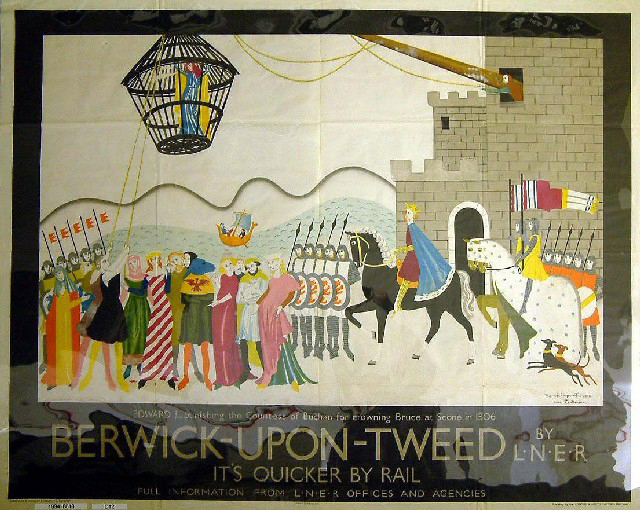
On the order of Edward I of England, Isabel Countess of Buchan was imprisoned in a cage for four years in Berwick-upon-Tweed. Poster artist: Doris Clare Zinkeisen (1898-1991). Source: the Science Museum Collection. Image released under a CC BY-NC-SA 4.0 Licence

Celebrating with Toni Scullion at the Edinburgh Napier University Alumni Awards 2025 ceremony

Edinburgh Napier University Alumni Awards trophies 2025

Awards winner trophies at the ceremony. Photo credit: Greg Macvean.

Congratulations to Toni Scullion, Computing Science teacher and co-lead of Scottish Teachers Advancing Computing Science (STACS). Toni was recognised as an Edinburgh Napier University Alumni Excellence Award winner at a ceremony at the University’s Craiglockhart campus last Thursday 6th November. Continue reading

Deadlines approach for next iConference, hosted by Edinburgh Napier University Spring 2026

iConference, 2026, banner, Edinburgh, Napier

There is still time to submit contributions to the next iSchools iConference. However, if you are working on a research paper (full or short), or a poster, next week’s Monday deadline is fast approaching. Continue reading

The People’s dispensary archive: launch event at the Royal College of Physicians of Edinburgh

people's, dispensary, launch, event, bannerOn Wednesday last week, I paid a visit to the Royal College of Physicians of Edinburgh. The purpose of my visit was to attend the launch event of a new online resource. The People’s dispensary brings together digitised case notes from the earliest years of the Edinburgh public dispensary. Continue reading

March 2025 work highlights

For a retired person, work-wise March 2025 has been a super-busy month for me. I have:

  • Helped edit a draft journal article manuscript
  • Provided feedback on documents related to the next Research Excellence Framework in 2029 (REF)
  • Prepared and delivered a presentation for archives and records professionals with Dr Bruce Ryan on our work on the Lorna Lloyd archive
  • Joined in the reboot of the Edinburgh Coffee Morning
  • Attended lectures on a range of topics ranging from radical thinking to dark matter
  • Written an award nomination for a former student who has achieved great things since graduating from Edinburgh Napier University in 2009
  • Submitted an abstract for a talk to be delivered in May 2025

Continue reading

Alice Thornton at the Festival of Cultural Heritage Research 2024

Alice Thornton's Books logoLast Thursday 18th April, I attended a session at the University of Edinburgh’s Festival of Cultural Heritage Research 2024 entitled Discovery and digitisation: Alice Thornton’s life and books (1626-1707). Continue reading

Creative informatics: unleashing the power of data – exhibition review

Edinburgh Science Festival 2024 brochure coverOn Thursday 4th April, I attended a private reception to celebrate the exhibition Creative Informatics: unleashing the power of data. The exhibition was hosted at the National Museum of Scotland as part of the Edinburgh Science Festival 2024 to mark the end of the funded phase of the Creative Informatics (CI) programme. Since its inception in 2018, Edinburgh Napier University has been one of the four partners of the CI programme alongside the University of Edinburgh, Creative Edinburgh and Codebase.

Over the past five years, the programme has supported individuals and organisations in the creative industries in Edinburgh and south east Continue reading

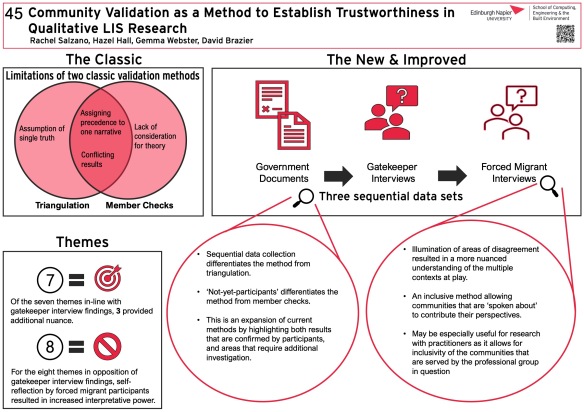
Community validation in qualitative research: contribution to #asist23

ASIST 2023 poster Salzano Hall Webster Brazier

Poster by Edinburgh Napier Social Informatics Research Group colleagues presented at #ASIST23

The main programme of the 2023 Annual Meeting of the Association for Information Science and Technology opens today in London. Sadly I cannot be there in person with my (lucky) Edinburgh Napier University Social Informatics Research Group colleagues*. Continue reading

All set for ECIL 2023

ECIL 2023 | European Conference on Information LiteracyThe 2023 European Conference on Information Literacy (ECIL2023) takes place in Krakow, Poland this coming week from Monday 9th until Thursday 12th October. Continue reading

Community validation as a method to establish trustworthiness in qualitative LIS research: submission accepted for #asist2023

ASIST 2023 #asist2023 logo LondonCommunity validation as a method to establish trustworthiness in qualitative LIS research has been accepted for the 86th Annual Meeting of the Association for Information Science and Technology. The conference takes place in London between 27th and 31st October this year.

This contribution to the conference poster session is an output from Dr Rachel Salzano‘s doctoral study. It was co-authored by Rachel and her supervision team members: Professor Hazel Hall, Dr Gemma Webster, and Dr David Brazier. Here we evaluate a novel means to determine trustworthiness in qualitative and mixed methods research, while making reference to Rachel’s doctoral study on the adoption and use of public library services by forced migrants. Continue reading