
Information Literacy for Democratic Engagement (IL-DEM) project: findings

Information Literacy group logoPeter Cruickshank, Dr Bruce Ryan and I recently completed the Information Literacy for Democratic Engagement (IL-DEM) project. This work set out to investigate levels of digital and information literacy within Scotland’s Community Council system. It was supported by a grant from the CILIP Information Literacy Group.

We explored how community councillors develop the skills required to inform and engage with the citizens that they represent, and how libraries support this work. In doing so have extended further two established research streams within the Centre for Social Informatics: (1) Cruickshank and Ryan’s work on digital engagement in local democracy (such as our DigiCC workshops), and (2) mine with Christine Irving on information literacy and life-long learning. This work also builds upon our group’s track record in library and information science research. Continue reading

Information Literacy for Democratic Engagement: project update #IL-DEM

Information Literacy group logoThe Centre for Social Informatics is currently undertaking a project entitled Information Literacy for Democratic Engagement (IL-DEM).  Supported by a grant from the CILIP Information Literacy Group, our work investigates levels of digital and information literacy within Scotland’s Community Council system.

Specifically Peter Cruickshank, Dr Bruce Ryan and I are exploring how community councillors develop the skills required to inform and engage with the citizens that they represent, and how libraries support this work. In doing so we’re extending two established research streams within the Centre for Social Informatics: Cruickshank and Ryan’s work on digital engagement in local democracy (such as our DigiCC workshops), and mine with Christine Irving on information literacy and life-long learning. This work also builds upon our group’s track record in library and information science research. Continue reading
Call for submissions to #eblip9, Philadelphia, USA, June 2017

EBLIP9 logoThe call for paper and poster proposals for the 9th International Evidence Based Library and Information Practice (EBLIP9) conference is now live.The conference takes between June 18th and 21st 2017 in Philadelphia, USA.

Submissions are invited on the broad conference theme of ’embedding and embracing evidence’. 300 word abstracts are invited for two types of contribution: (1) full papers (to be delivered in a 30 minute slot at the conference); and (2) posters. Those whose work is accepted for a paper presentation will also be encouraged to submit a full paper to the journal Evidence Based Library and Information Practice following the conference. Continue reading

Demographics of the UK information professions: fact sheets published by CILIP and ARA

This week the Chartered Institute of Library and Information Professionals (CILIP) and the Archives and Records Association (ARA) published a series of 24 fact sheets on the demography of the UK workforce in libraries, archives, records, information management, and knowledge management. The data, presented in the fact sheets by sector and region, derive from the findings of the Workforce Mapping Project.

This project was completed in 2014/15 by an Edinburgh Napier University team that comprised three staff from the Centre for Social Informatics (Hazel Hall, Christine Irving and Bruce Ryan) and three from the Employment Research Institute (Robert Raeside, Tao Chen and Matthew Dutton). In November 2015 CILIP and ARA used data from the final project report to publish the headline findings from the study. Continue reading

Frances Ryan presents on online reputation management at #DARTS5

Frances Ryan

Frances Ryan

Centre for Social Informatics PhD student Frances Ryan is an invited speaker at the 5th annual Discover Academic Research, Training, and Support (DARTS) conference.

This two day event, which takes place today and tomorrow at Dartington Hall in Devon, focuses on engendering (digital) research culture. It includes sessions on open access publishing, embedding digital research in teaching, bibliometrics, and information literacy. Follow the conference on Twitter using hashtag #darts5. Continue reading

Strategies for building and assessing the long-term impact of research projects: closing plenary at #QQML2016

Today I am at Senate House in London as an invited speaker at the 8th International Conference on Qualitative and Quantitative Methods in Libraries. The conference has a packed programme of over 150 contributions. It started on Tuesday morning and ends with my presentation. Entitled What happens next? Strategies for building and assessing the long-term impact of research projects, the presentation covers four main themes: Continue reading

Research impact from LISResearch.org to LISResearch.org.au #LISRAproject

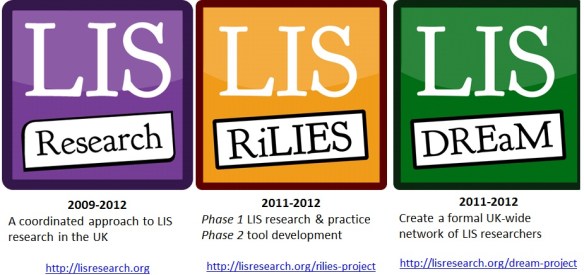
LIS Research Coalition DREaM RiLIES logosBetween 2009 and 2012 I led the implementation of the UK’s Library and Information Science Research Coalition. The broad mission of the Coalition was to facilitate a coordinated and strategic approach to Library and Information Science (LIS) research across the UK, strengthening links between LIS researchers and LIS practitioners, and between research and practice. This was achieved through the activities of the Coalition as a whole, and its ‘daughter’ projects: Developing Research Excellence and Methods (DREaM), and the two-part Research in Librarianship Impact Evaluation Study. Continue reading

Who is the ‘typical’ UK information worker? Headline findings of the CILIP/ARA Workforce Mapping Project

Workforce Mapping Project executive summary

The executive summary is available from the CILIP web site

Last week the Chartered Institute of Library and Information Professionals (CILIP) and the Archives and Records Association (ARA) held a launch event in London. Here an executive summary of the Workforce Mapping Project, with which I have been heavily involved over the past 15 months, was presented. The summary distributed at the launch notes key findings of the study.

These include:

  • The estimated size of the UK workforce in the Library, Archives, Records, Information Management, and Knowledge Management professions is 86,376.
  • Women dominate the workforce (78.1% of the workforce is female, and 21.9% male), yet earn less than men, and are not so well represented in senior management positions.
  • The workforce is highly qualified: 61.4% hold postgraduate academic qualifications.
  • The workforce is ageing: 55.3% of its members are over 45 years of age. (The equivalent figure for the UK workforce as a whole is 41.1%.)
  • There is low ethnic diversity in the workforce: 96.7% identify as ‘white’.

Continue reading

University of Toronto iSchool/Knowledge Media Design Institute Colloquia Series presentation

iSchool Toronto logoThis afternoon I will be delivering a presentation as part of the colloquia series of the iSchool and Knowledge Media Design Institute (KMDI) at the University of Toronto. Continue reading