
There is still time to submit contributions to the next iSchools iConference. However, if you are working on a research paper (full or short), or a poster, next week’s Monday deadline is fast approaching. Continue reading

There is still time to submit contributions to the next iSchools iConference. However, if you are working on a research paper (full or short), or a poster, next week’s Monday deadline is fast approaching. Continue reading
 Dr Marina Milosheva’s full PhD thesis Career information literacy and the decision-making behaviours of young people is now available from the Edinburgh Napier repository.
On the basis of the ESRC/SDS-funded empirical work reported in the thesis, Marina presents three main contributions to theory:
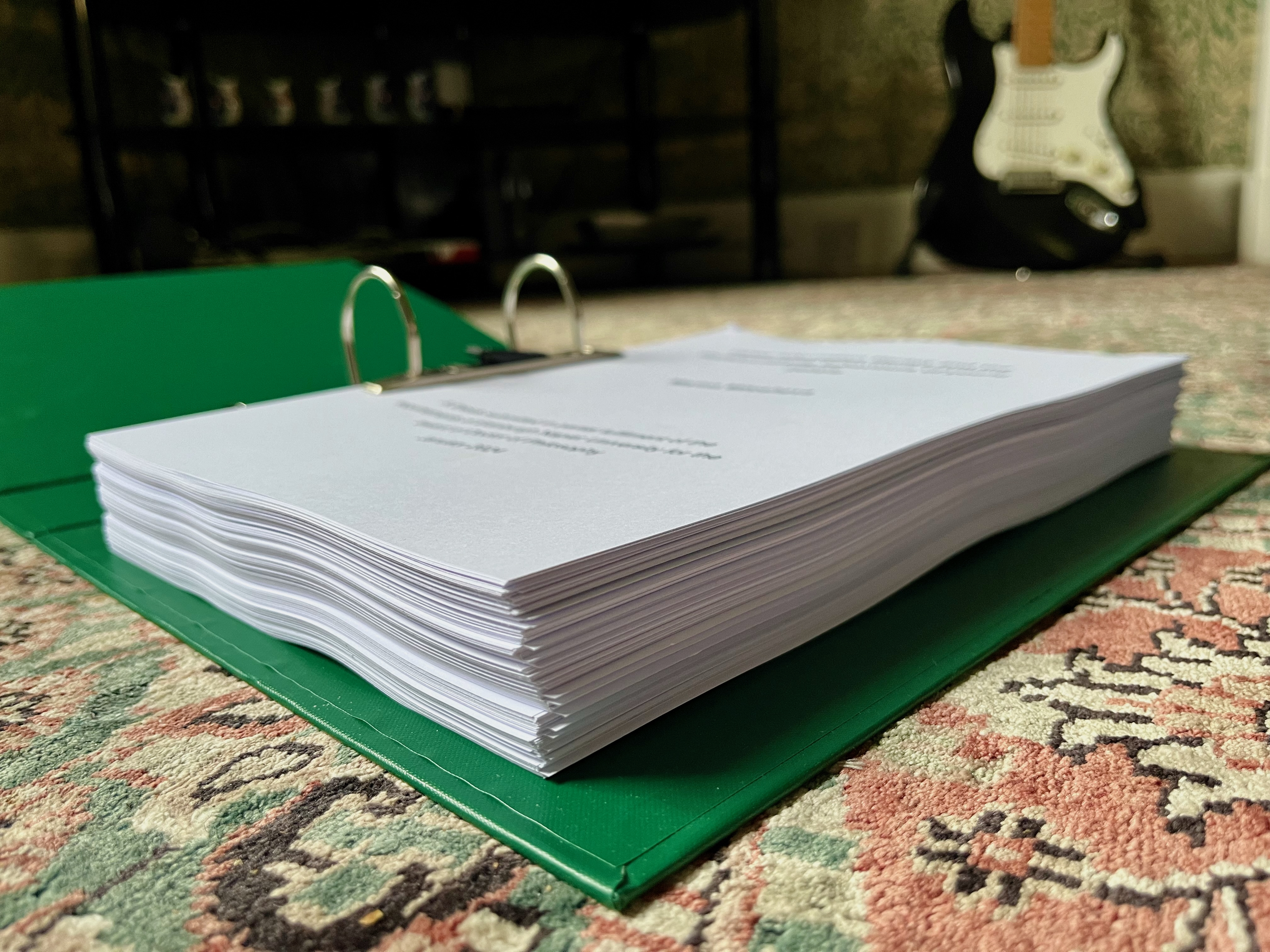
Marina Milosheva’s draft PhD thesis
I have been a little quiet on this blog over the past five months or so. The main reason for this is that I have taken on a further role in addition to that of Emeritus Professor. I am now Continue reading
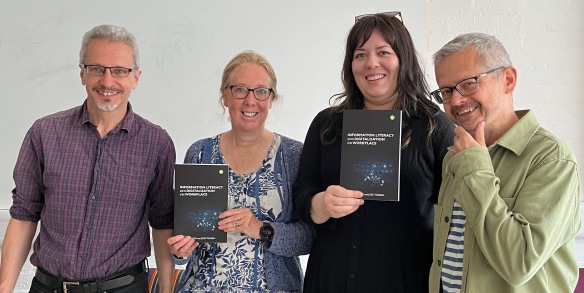
L to R: chapter co-authors Pete Robertson, Hazel Hall, Marina Milosheva, and Peter Cruickshank
Information literacy and the digitalisation of the workplace has recently been published by Facet. I picked up my copy of the book this morning when I was on campus for a meeting with my fellow co-authors of Chapter 6: Marina Milosheva, Pete Robertson, and Peter Cruickshank (pictured above). Continue reading
‘From a network model to a model network: strategies for network development to narrow the LIS research–practice gap’ has just been published. This paper, which I co-authored with my Edinburgh Napier University colleagues Dr Bruce Ryan, Rachel Salzano, and Katherine Stephen, can be found in issue 3 of volume 79 of the Journal of Documentation, and is available as a full-text download from the publisher. Continue reading
 Along with my co-authors Marina Milosheva, Pete Robertson, and Peter Cruickshank, I am excited to see that the details of Information literacy and the digitalization of the workplace are now available in Facet’s publishing catalogue.
The anticipated publication of the book next month on 13th April comes just over two years since its first editor Gunilla Widén (Åbo Akademi University, Finland) initially approached me about the possibility of contributing to this new work. The conversation ultimately led to the preparation of a chapter that draws primarily on some of the research that PhD student Marina Milosheva has undertaken for her ESRC/Skills Development Scotland funded doctoral study on career information literacy and career decision-making, and team discussions in Marina’s supervision meetings. In it we focus on the importance of employability information literacy and career information literacy to sustainable employment in largely digitised work environments. Continue reading

Congratulations to Professor Diane Pennington and Dr Debbie Meharg of the Social Informatics Research Group at Edinburgh Napier University. With the support of the Dean Professor Peter Andras, they have led the work that has resulted in the recent acceptance of the University’s School of Computing, Engineering and the Built Environment (SCEBE) as a member of the international iSchools network. Continue reading
Amongst the latest articles published online ahead of print by the Journal of Documentation is one on narrowing the research-practice gap that I have recently co-authored with my Edinburgh Napier University colleagues Dr Bruce Ryan, Rachel Salzano, and Katherine Stephen.

This JDoc paper is now available for download from Emerald EarlyCite
 Today Centre for Social Informatics PhD student Marina Milosheva is delivering a presentation entitled ‘What is career information literacy and what can it do for you?’ at the second Research and information literacy skills in the workplace seminar hosted by Cape Peninsula University of Technology (CPUT) Libraries. Continue reading
 From a network model to a model network: strategies for network development to narrow the LIS research-practice gap has been accepted for publication in the Journal of Documentation. I recently co-authored this article with my Edinburgh Napier University colleagues Dr Bruce Ryan, Rachel Salzano, and Katherine Stephen.
In this article we discuss the applicability of strategies shown to work well in one model of network development to the development of another. It in an output of the Research Impact Value and LIS (RIVAL) project, funded by the Royal Society of Edinburgh between 2019 and 2021. We used the grant to bring together a collaborative network of Scotland-based Library and Information Science (LIS) researchers and practising library and information professionals interested in maximising the impact and value of library and information science research. Continue reading
 Hazel Hall