‘Podcasting the archive: an evaluation of audience engagement with a narrative non-fiction podcast series’ published

cover image Archives: The Journal of the British Records Association‘Podcasting the archive: An evaluation of audience engagement with a narrative non-fiction podcast series’ is now available in issue 2 of volume 28 of Archives, published last month. I am a co-author of the article alongside Dr Bruce Ryan, Marianne Wilson, and Dr Iain McGregor.

In this work we compare audience engagement with a Second World War archive presented digitally in two formats as: (1) images and text in a Blipfoto journal, and (2) sound in an eight-episode podcast series (which starts with episode 1 here). The main findings reveal differences in levels of engagement for each presentation in respect of entertainment value, learning opportunities, and emotional response. Flexibility of access and authenticity of the archived material were also found to be important to audience engagement, with the nature of contextual information provided alongside the core archive key to the latter. Here we further understanding of facets of audience engagement with digitised archives while opening up new thinking on means of encouraging the general public to interact in more meaningful ways with historical records. Continue reading

Article accepted by ‘Archives’ on audience engagement with podcast series

platform, logo, Lorna, Lloyd, war, diary‘Podcasting the archive: an evaluation of audience engagement with a narrative non-fiction podcast series’ has been accepted for publication by Archives journal in October 2024. This contribution is the main output of the AHRC-Creative Informatics funded Platform to platform project. It is co-authored by Dr Bruce Ryan, Professor Hazel Hall, Marianne Wilson, and Dr Iain McGregor. Continue reading
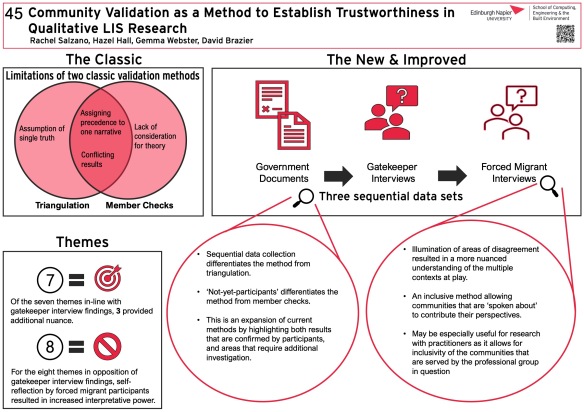
Community validation in qualitative research: contribution to #asist23

ASIST 2023 poster Salzano Hall Webster Brazier

Poster by Edinburgh Napier Social Informatics Research Group colleagues presented at #ASIST23

The main programme of the 2023 Annual Meeting of the Association for Information Science and Technology opens today in London. Sadly I cannot be there in person with my (lucky) Edinburgh Napier University Social Informatics Research Group colleagues*. Continue reading

All set for ECIL 2023

ECIL 2023 | European Conference on Information LiteracyThe 2023 European Conference on Information Literacy (ECIL2023) takes place in Krakow, Poland this coming week from Monday 9th until Thursday 12th October. Continue reading

Community validation as a method to establish trustworthiness in qualitative LIS research: submission accepted for #asist2023

ASIST 2023 #asist2023 logo LondonCommunity validation as a method to establish trustworthiness in qualitative LIS research has been accepted for the 86th Annual Meeting of the Association for Information Science and Technology. The conference takes place in London between 27th and 31st October this year.

This contribution to the conference poster session is an output from Dr Rachel Salzano‘s doctoral study. It was co-authored by Rachel and her supervision team members: Professor Hazel Hall, Dr Gemma Webster, and Dr David Brazier. Here we evaluate a novel means to determine trustworthiness in qualitative and mixed methods research, while making reference to Rachel’s doctoral study on the adoption and use of public library services by forced migrants. Continue reading

Trapped in the wrong job? Marina Milosheva offers advice in her latest contribution to ‘The Conversation’

Marina Milosheva

Marina Milosheva

What can you do when you feel like you are trapped in a job that leaves you feeling unfulfilled, or you find yourself in a role for which you are over-qualified and that does not allow you to use the full extent of your talents and skills?

Edinburgh Napier University Social Informatics PhD student Marina Milosheva addresses these questions in a new article for The Conversation entitled Why it’s so difficult to figure out what to do with your life – and three steps to take. The article is a contribution to The Conversation‘s Quarter Life series on issues that affect those in their twenties and thirties. Continue reading

A contribution to the RIVAL reunion

Last month, on May 25th 2023, I enjoyed the novelty of participating at a RIVAL network event not as an organiser, but as an invited speaker. Expertly coordinated by Dr Bruce Ryan and Professor Diane Pennington, the event was funded by Edinburgh Napier University with additional sponsorship from McMaster University, Canada (the keynote speaker was Professor Brian Detlor), CILIPS, and SLIC. Continue reading

Information literacy competencies for career transitions in the digital age: book chapter now published

Pete Robertson, Hazel Hall, Marina Milosheva, Peter Cruickshank

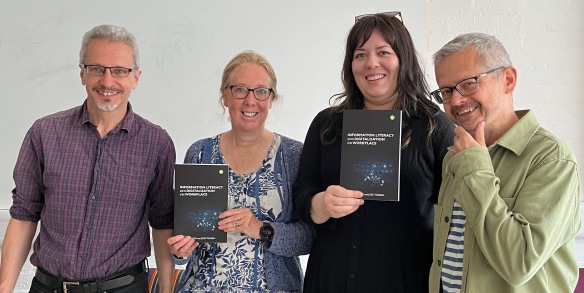
L to R: chapter co-authors Pete Robertson, Hazel Hall, Marina Milosheva, and Peter Cruickshank

Information literacy and the digitalisation of the workplace has recently been published by Facet. I picked up my copy of the book this morning when I was on campus for a meeting with my fellow co-authors of Chapter 6: Marina Milosheva, Pete Robertson, and Peter Cruickshank (pictured above). Continue reading

Developing the Young Workforce evaluation: evidence synthesis by Marina Milosheva now available

Developing the Young Workforce evaluation: evidence synthesis, Marina Milosheva

Marina Milosheva authored the report

Last autumn, Social Informatics Research Group PhD student Marina Milosheva completed a 13-week internship administered through the Scottish Graduate School of Social Scottish Science (SGSSS) internship scheme.

In this period, Marina worked in the Advanced Learning and Skills Analysis Unit of the Scottish Government. With a remit to improve the lives of children and young people in Scotland through raising educational standards, this Unit is a part of the Scottish Government’s Learning Directorate. Continue reading

Information literacy and the digitalization of the workplace: new book to be published on 13th April 2023

Along with my co-authors Marina Milosheva, Pete Robertson, and Peter Cruickshank, I am excited to see that the details of Information literacy and the digitalization of the workplace are now available in Facet’s publishing catalogue.

The anticipated publication of the book next month on 13th April comes just over two years since its first editor Gunilla Widén (Åbo Akademi University, Finland) initially approached me about the possibility of contributing to this new work. The conversation ultimately led to the preparation of a chapter that draws primarily on some of the research that PhD student Marina Milosheva has undertaken for her ESRC/Skills Development Scotland funded doctoral study on career information literacy and career decision-making, and team discussions in Marina’s supervision meetings. In it we focus on the importance of employability information literacy and career information literacy to sustainable employment in largely digitised work environments. Continue reading