Workplace information literacy: a bridge to the development of Innovative Work Behaviour is a new paper about information-related determinants of Innovative Work Behaviour (IWB). I co-authored this paper with Dr Lyndsey Middleton, drawing on the findings of Lyndsey’s ESRC/Skills Development Scotland-funded doctoral research* completed within the Centre for Social Informatics. The paper was accepted for publication in the Journal of Documentation last week. Continue reading
Using a multi-location, longitudinal focus group method to conduct qualitative research into the role of public libraries #QQML2021

Dr Leo Appleton
The 13th Qualitative and Quantitative Methods in Libraries International Conference (QQML2021) takes place this week from Tuesday 25th until Friday 28th May. At the conference, Dr Leo Appleton, who completed his doctoral study within the Centre for Social Informatics last year, is presenting a paper that he and I have co-authored.
Entitled ‘Using a multi-location, longitudinal focus group method to conduct qualitative research into the role of public libraries‘, the theme of our paper is the novel multi–location longitudinal focus group method that Leo adopted for the empirical phase of his PhD research on the role of UK public libraries. In his presentation slot on Tuesday, Leo will discuss the value of data collection from fifty–three participants in three rounds of focus group meetings in eight UK public library authorities. He will explain that this approach generated a rich data set for qualitative analysis. In particular, he will draw attention to the increasing level of sophistication and depth of discussion amongst the study participants over the course of the three rounds of focus group meetings. Leo will also acknowledge participant attrition as the main drawback of this approach. Continue reading
Contributions sought: What does the public library mean to refugees and asylum speakers?
Centre for Social Informatics PhD student Rachel Salzano is currently seeking submissions for a public exhibition of art work to represent the reasons that refugees and asylum seekers use UK public library services. Rachel will be pleased to feature all types of art work in the exhibition, including, for example, photographs, paintings, collages, and 3D creations. Continue reading
Fully-funded PhD opportunity: labour market intelligence and machine learning

We invite applications for a fully-funded PhD studentship within the Centre for Social Informatics at Edinburgh Napier University.
The studentship is entitled Enhancing labour market intelligence using machine learning. It is suitable for holders of undergraduate or Masters degrees in subjects such as Business Information Systems, Business Studies, Computing, Data Science, or Information Science, Continue reading
Introducing the Edinburgh Napier University Social Informatics blog
Over the past couple of months, my colleague Peter Cruickshank has been leading work on the development a new collaborative blog to showcase the work of our research group at Edinburgh Napier University. Continue reading
Opportunity for refugees and asylum seekers to contribute to research on UK public library services
Do you know or work with adult refugees and/or asylum seekers who have lived in the UK for 5 years or fewer? If so, please could you let them know about this opportunity to contribute to an on-going research project within the Centre for Social Informatics by completing a short online questionnaire at tinyurl.com/culturepubliclibraries. Continue reading
Spreading the news of RIVAL at the SCURL and CILIPS 2021 conferences, and in Information Professional
This year’s annual conference of the Scottish Confederation of University and Research Libraries (SCURL) takes place online on Wednesday 9th June 2021. Registration are free of charge on EventBrite.
The conference will bring together SCURL members to share ideas and experiences to shape library services in the future. There will be a particular focus on adaptations and innovations across SCURL libraries during the past year, taking into account the impact of the coronavirus pandemic on library service delivery. Continue reading
Two contributions from the Centre for Social Informatics accepted at European Conference on Information Literacy #ECIL2021
The European Conference on Information Literacy 2021 (ECIL2021) will be hosted by University of Bamberg as an online event between 20th and 23rd September 2021. Six members of the Centre for Social Informatics (CSI) have contributed to two outputs accepted for the conference. Continue reading
Peter Cruickshank appointed to the programme committee of 10th International Conference on Electronic Government and the Information Systems Perspective (EGOVIS2021)
Peter Cruickshank of the Centre for Social Informatics has been appointed to the programme committee of the 10th International Conference on Electronic Government and the Information Systems Perspective (EGOVIS2021). This appointment recognises Peter’s established track record of research in e-government, particularly on e-participation at hyperlocal levels. See, for example, Cruickshank, Hall & Ryan (2020). Continue reading
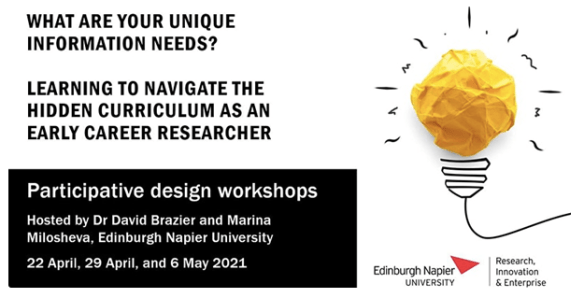
Navigating the hidden curriculum: workshops for early career researchers
My Centre for Social Informatics colleagues Dr David Brazier and Marina Milosheva are taking bookings for a series of participative design workshops for early career researchers. These take place on three consecutive Thursday mornings: 22nd and 29th April, and May 6th. The aim of the workshops is for participants to develop the skills required to benefit from informal learning in academia. The programme is described in greater detail in a recent post on Marina’s web site. Continue reading