
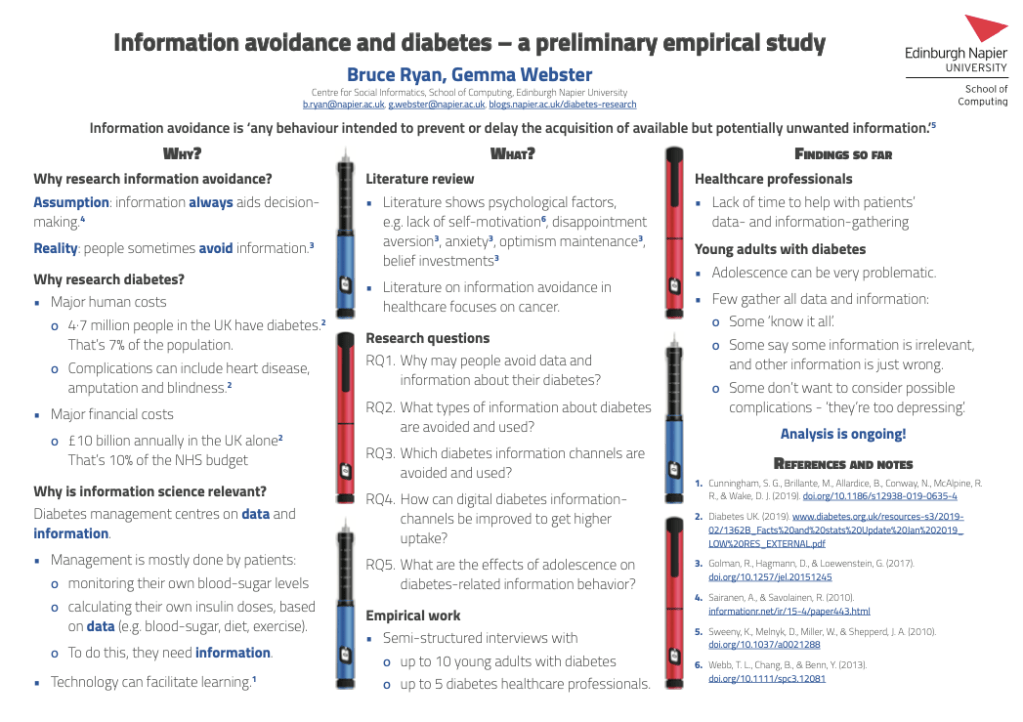
Bruce Ryan and Gemma Webster present on information avoidance and diabetes at Information Science Trends: Health Information Behavior

Next week on Monday 8th June Centre for Social Informatics colleagues Dr Bruce Ryan and Dr Gemma Webster are presenting a poster at Information Science Trends: Health Information Behavior. This free virtual event takes place over 3 days between 8th and 10th June in three 3-hour sessions. It has been organised by the European Chapter of the Association for Information Science and Technology (ASIST). Continue reading

Rachel Salzano contributes to the work of the Alan Turing Institute

Rachel Salzano

Rachel Salzano

The Alan Turing Institute is the UK’s national institute for data science and artificial intelligence. It was established in 2015 with headquarters at the British Library in London. The work of the Institute is achieved through collaborations between universities, businesses, and public and third sector organisations to address some of the biggest challenges in science, society and the economy.

Currently Rachel Salzano, a PhD student within the Centre for Social Informatics at Edinburgh Napier University, is contributing to the institute’s research on detecting and understanding harmful content online. She has been employed by the Institute in two roles. Continue reading

Hyperlocal democracy, tacit knowledge sharing, digital youth participation, and online reputation building and management: four more papers in JoLIS

Journal of Librarianship and Information ScienceThe last four articles of the seven that I developed with Centre for Social Informatics colleagues from the conference papers that we presented at i3 in 2017 have worked their way through the publication process, and can now be found in the print form with assigned volume, issue and page numbers in the Journal of Librarianship and Information Science. The article titles and themes are: Continue reading

Newly published: version 10 of the Centre for Social Informatics flyer (February 2020)

Centre for Social Informatics bannerWe have a newly updated Centre for Social Informatics flyer (version 10, no less!) Please follow the link to read about the work of our group, including details of research expertise, funders, recent PhD completions, and recent publications. The flyer includes profiles of the academic and research staff within our group: Continue reading

Fully-funded PhD studentship opportunity: Natural language interfaces to support career decision-making of young people

ESRC-SDS-Napier studentship logos

Updated with new deadline: midday 30th April 2020

We are currently advertising a fully-funded PhD place within the School of Computing at Edinburgh Napier University for an October 2020 start date. Continue reading

Social Informatics colleagues at the School of Computing New Year research conference 2020

Yesterday, on 15th January 2020, the School of Computing at Edinburgh Napier University held its annual New Year research conference. The format of the event included sessions on REF2021 led by Professor Ben Paechter and Professor Emma Hart, good practice in PhD supervision led by Professor Ahmed Al-Dubai, data management plans led by Dr Lindsay Ramage, research culture led by Dr Frances Ryan, and a series of short presentations on on-going research projects within the School. There were also good opportunities for networking in the breaks. Continue reading

Newly published: autumn 2019 edition of the Centre for Social Informatics flyer

We have a newly updated Centre for Social Informatics flyer for autumn 2019. Please follow the link to read about the work of our group, including details of research expertise, funders, recent PhD completions, and recent publications. The flyer includes profiles of the academic and research staff within our group: Continue reading

An award and an appointment at ASIST in Australia #asist2019 #asist19

Last week many members of the worldwide Information Science community gathered in Melbourne, Australia for the 82nd Annual Meeting of the Association for Information Science and Technology (ASIST). I was sorry not to be there myself. This was due to my teaching commitments this semester, in particular my final year undergraduate Knowledge Management module.

Abebe Rorissa, Brian Detlor, #asist2019, #asist19, Hazel Hall, Clarivate, teacher, award

Dr Abebe Rorissa presents Dr Brian Detlor with Hazel’s ‘Outstanding Information Science Teacher’ award (Photo credit: Becky Willson)

Despite my lack of physical presence at the conference, I kept an eye on the hash-tagged tweets from the event (#asist2019; #asist19). I was particularly interested in the Twitter stream around breakfast time (in the UK) on Tuesday 22nd October when the delegates in Melbourne were sitting down for the conference dinner and awards ceremony. This was because Visiting Professor to the Centre for Social Informatics Dr Brian Detlor had kindly agreed to step up to the stage to accept the 2019 Clarivate Analytics Outstanding Information Science Teacher Award on my behalf.

The award was presented by Abebe Rorissa of the University of Albany – thank you! I should also thank Rebekah (Becky) Willson of McGill University for taking photographs during the presentation. Continue reading

Congratulations to Katherine Stephen for an excellent Masters dissertation on metaskills

Katherine Stephen

Katherine Stephen

Congratulations to our PhD student Katherine Stephen, who last week learnt that she was awarded 80% for the Masters dissertation component of her 1+3 PhD. Katherine’s studentship is a collaborative award funded by the ESRC and Skills Development Scotland, and comprises a Masters year at the University of Edinburgh (2018/19) prior to three years of doctoral study at Edinburgh Napier University (2019/22).

Katherine’s Masters dissertation took the form of an extended PhD proposal, and thus has the same title as her doctoral study: Metaskills maturity for future workplaces. The work that she completed for the dissertation last year included a small pilot study entitled Metacognitive experiences of artificial intelligence in the workplace.

In her dissertation Continue reading

Social cognitive theory literature review article now in print

‘Applications and applicability of Social Cognitive Theory in information science research’ is now available in issue 51(4) (December 2019) of the Journal of Librarianship and Information Science (JoLIS). The article covers the origins and key concepts of Social Cognitive Theory (SCT) and its value to Information Science research. Particular reference is made to the applicability of SCT – and its applications – in studies of information-seeking behaviour and use, and knowledge sharing. Continue reading