Congratulations Dr Marina Milosheva!

Napier graduate pub Shakespeare Edinburgh

Shakespeare’s pub on Lothian Road was transformed into the Napier Graduate last week

Congratulations to Dr Marina Milosheva, whose doctoral degree was conferred in absentia at the Edinburgh Napier graduation ceremony at the Usher Hall in Edinburgh last Friday 5th July. Although Marina did not attend the ceremony in person, this day was a significant milestone in her PhD journey. This is because it is only from the date of the graduation ceremony that new PhD graduates are permitted to place the term ‘Dr’ before their names. Continue reading

What can you do with a PhD? Ten answers from graduates who completed their doctoral studies between 2015 and 2023

One of the questions most often asked of doctoral students is What are you going to do when you finish your PhD? For some students it is also one of the most dreaded, especially when it comes from family members or friends who barely understand the title of the doctoral research in question. An obvious, and truthful, answer is ‘No longer work on my thesis’. However, this isn’t really a suitable response. The questioner is interested in hearing about ‘proper’ job ambitions, and the value of these to a successful future career. Continue reading

A new role at the University of Stirling for Marina Milosheva

Marina Milosheva

Marina Milosheva

Congratulations to Marina Milosheva on her appointment as post-doctoral researcher within the Faculty of Social Sciences (Sociology, Social Policy and Criminology division) at the University of Stirling. Marina joined the University of Stirling on Monday, five weeks after her PhD examiners recommended that Edinburgh Napier University award her doctorate unconditionally (i.e. with no corrections required to her thesis).

In her new role, Marina is working on the Bridge, youth, and mindsport education project. This research is affiliated with the non-profit organisation Bridge: a mindsport for all (BAMSA). This body was formed to support research into the sociology of the card game bridge. Continue reading

How do young people and careers advisers collaborate in their use of careers information? New publication in the Australian Journal of Career Development

The collaborative use of career information by young people and career advisers: a thematic content analysis of career counselling records has been published in the April 2024 issue of the Australian Journal of Career Development. I am one of the co-authors of this article alongside Marina Milosheva, Professor Pete Robertson, and Dr Peter Cruickshank.
In this work we discuss the information behaviours of young people and careers advisers. We highlight three modes of information seeking: (1) that prompted by careers advisers; (2) that undertaken by careers advisers on behalf of young people; and (3) that completed collaboratively by young people with their careers advisers. The patterns of the interactions, the language deployed over their duration, and the roles of each set of actors in the process of information seeking, point to ways in which career services may be improved, and career information, advice and guidance policies developed. Continue reading

Community validation in qualitative research: contribution to #asist23

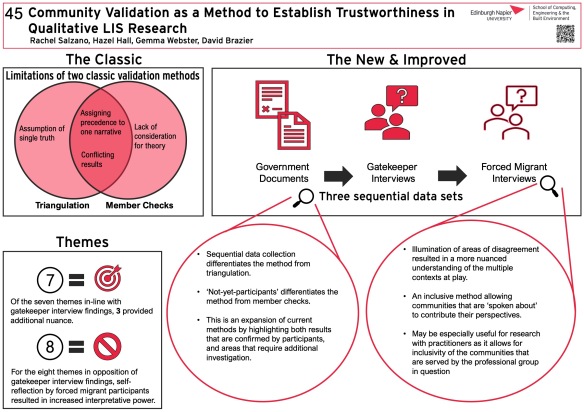
ASIST 2023 poster Salzano Hall Webster Brazier

Poster by Edinburgh Napier Social Informatics Research Group colleagues presented at #ASIST23

The main programme of the 2023 Annual Meeting of the Association for Information Science and Technology opens today in London. Sadly I cannot be there in person with my (lucky) Edinburgh Napier University Social Informatics Research Group colleagues*. Continue reading

All set for ECIL 2023

ECIL 2023 | European Conference on Information LiteracyThe 2023 European Conference on Information Literacy (ECIL2023) takes place in Krakow, Poland this coming week from Monday 9th until Thursday 12th October. Continue reading

Community validation as a method to establish trustworthiness in qualitative LIS research: submission accepted for #asist2023

ASIST 2023 #asist2023 logo LondonCommunity validation as a method to establish trustworthiness in qualitative LIS research has been accepted for the 86th Annual Meeting of the Association for Information Science and Technology. The conference takes place in London between 27th and 31st October this year.

This contribution to the conference poster session is an output from Dr Rachel Salzano‘s doctoral study. It was co-authored by Rachel and her supervision team members: Professor Hazel Hall, Dr Gemma Webster, and Dr David Brazier. Here we evaluate a novel means to determine trustworthiness in qualitative and mixed methods research, while making reference to Rachel’s doctoral study on the adoption and use of public library services by forced migrants. Continue reading

Congratulations Dr Rachel Salzano!

Dr Rachel Salzano

Rachel Salzano at the Usher Hall just before the start of the graduation ceremony

Congratulations to Dr Rachel Salzano, who was awarded her PhD at the Edinburgh Napier graduation ceremony at the Usher Hall in Edinburgh last Friday 7th July.

I supervised Rachel’s doctoral work alongside Dr Gemma Webster and Dr David Brazier. Given that Rachel was only five and a half months into her doctoral study when the UK went into the first of the COVID19 lockdowns* in March 2020, we consider it a real achievement that she managed to complete her empirical work, write it up, and submit her thesis in October 2022, exactly three years after joining our research group.

Rachel’s doctoral study is entitled The influence of culture on perceived use of public libraries by forced migrants in Scotland and England. Continue reading

Information literacy competencies for career transitions in the digital age: book chapter now published

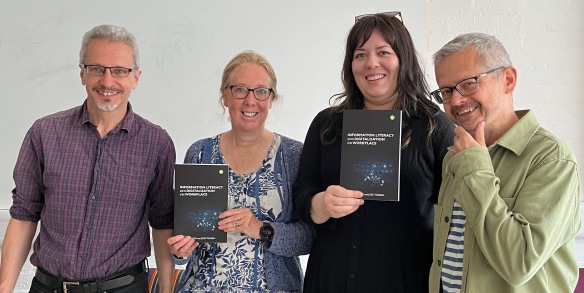
Pete Robertson, Hazel Hall, Marina Milosheva, Peter Cruickshank

L to R: chapter co-authors Pete Robertson, Hazel Hall, Marina Milosheva, and Peter Cruickshank

Information literacy and the digitalisation of the workplace has recently been published by Facet. I picked up my copy of the book this morning when I was on campus for a meeting with my fellow co-authors of Chapter 6: Marina Milosheva, Pete Robertson, and Peter Cruickshank (pictured above). Continue reading

Developing the Young Workforce evaluation: evidence synthesis by Marina Milosheva now available

Developing the Young Workforce evaluation: evidence synthesis, Marina Milosheva

Marina Milosheva authored the report

Last autumn, Social Informatics Research Group PhD student Marina Milosheva completed a 13-week internship administered through the Scottish Graduate School of Social Scottish Science (SGSSS) internship scheme.

In this period, Marina worked in the Advanced Learning and Skills Analysis Unit of the Scottish Government. With a remit to improve the lives of children and young people in Scotland through raising educational standards, this Unit is a part of the Scottish Government’s Learning Directorate. Continue reading