
Workforce Data Consortium issues invitation to tender for Workforce Mapping Survey 2021/22

The Edinburgh Napier University Workforce Mapping Project team, 2014/15

In 2014/15 I led an Edinburgh Napier University team on a research project to profile the UK information professions. My colleagues were Christine Irving (now retired) and Dr Bruce Ryan of the Centre for Social Informatics; and Professor Robert Raeside (also retired), Dr Matthew Dutton, and Dr Tao Chen (now at the University of Bradford) of the Employment Research Institute. The output was a 186-page report (inclusive of 20 figures and 97 tables of statistics). Continue reading

Call to UK public library staff (any level) to contribute to study on services for refugees and asylum seekers

Do you work with refugees and/or asylum seekers (forced migrants) as part of your role in a UK public library? Can you assist a PhD student with her study on forced migrants’ use of UK public libraries? Perhaps you have colleagues or other contacts who could help out?

Rachel Salzano of Edinburgh Napier University seeks public library staff (at any level) willing to take part in interviews about their experience of delivering public library services to forced migrants. The interviews last approximately 1 hour and are organised at the interviewee’s convenience. Please contact Rachel on the form at https://librariansanslibrary.weebly.com/contact or email r.salzano@napier.ac.uk to contribute to this important work.

Evaluation of engagement with hyperlocal e-participation systems by citizens and representatives: thesis PDF now available

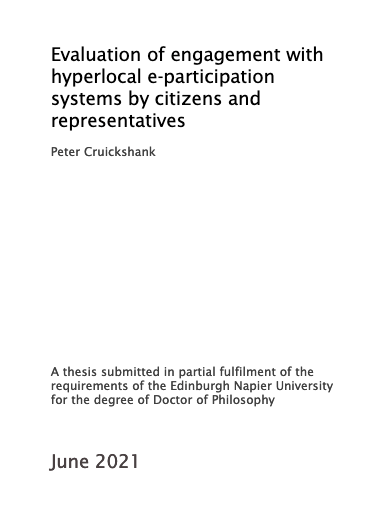
Peter Cruickshank PhD title pageIn July 2021 my Centre for Social Informatics colleague Peter Cruickshank was awarded a doctoral degree for his thesis Evaluation of engagement with hyperlocal e-participation systems by citizens and representatives.

The pdf of the thesis is now freely available for download from the Edinburgh Napier University repository. It will be of interest to all who conduct research on information behaviour and use, and particularly those investigating themes such as everyday life information seeking and information literacy in the context of e-participation. Continue reading

An award for Marianne Wilson

Natural language interfaces to support career decision-making of young people Marianne Wilson TMT three minute thesisCongratulations to Centre for Social Informatics research student Marianne Wilson, winner of the Masters award in the Skills Development (SDS) Scotland Virtual 3MT competition 2021. Continue reading

Dr David Brazier and Marina Milosheva present this week at ECIL 2021 #ecil2021 #ecil21 #infolit

The European Conference on Information Literacy 2021 (ECIL2021) opens today, running for three days until Thursday 23rd September. The work of the Centre for Social Informatics (CSI) will be represented in two presentations at this online event. Continue reading

Dr Bruce Ryan is long-listed for a national award

Dr Bruce Ryan

Dr Bruce Ryan

Dr Bruce Ryan, Senior Research Fellow in the Centre for Social Informatics at Edinburgh Napier University, has been long-listed for Scotland’s Library and Information Professional of the Year Award 2021.

This is in recognition of Bruce’s contributions to library and information science (LIS) research in the past year, particularly in respect of the Research Impact Value and LIS (RIVAL) project and conferences hosted by the Chartered Institute of Library and Information Professionals Scotland (CILIPS).

For further information about the award, including details of the other five long-listed candidates and sponsor Bolinda Digital, please see the post on the CILIPS web site.

Updated Centre for Social Informatics flyer (v13) and an opportunity to join us

Centre for Social Informatics flyer version 13A new version (V13) of the Centre for Social Informatics flyer is now available from the Social Informatics blog on the Edinburgh Napier University web pages. Please follow the link to read about the work of our research group, including details of research expertise, funders, recent PhD completions, and recent publications. The flyer also profiles the thirteen academic and research staff within the research group, alongside our nine current research students.

Normally we wouldn’t publish a new version of our flyer at this time of year. Instead we would wait until after our next intake of PhD students in October. However, some of our staff have recently changed titles/job roles, so we wanted to reflect their achievements in the document now. Continue reading

An internship with Marine Scotland for Katherine Stephen

Marine Scotland Scottish Government logoToday Centre for Social Informatics PhD student Katherine Stephen starts a 3-month paid internship with Marine Scotland. The internship has been organised through the Scottish Graduate School of Social Scottish Science (SGSSS) internship programme, and is funded by the Scottish Government. Continue reading

Newly published and available online from Emerald ‘Workplace information literacy: a bridge to the development of Innovative Work Behaviour’

Middleton Hall workplace information literacy innovative work behaviour behavior article headerWorkplace information literacy: a bridge to the development of innovative work behaviour is an article that I recently co-authored with Dr Lyndsey Middleton. It is now available as a PDF from the Journal of Documentation. (The manuscript of this paper is also available on the Edinburgh Napier repository for those who do not have subscription access to the Journal of Documentation). Continue reading

Katherine Stephen to present on the Imitation Game at the BSA Work, Employment and Society conference 2021

Katherine Stephen

Katherine Stephen

Congratulations to Centre for Social Informatics PhD student Katherine Stephen on the acceptance of a paper that she submitted for presentation at the British Sociological Association Work, Employment and Society conference 2021.

Katherine’s paper is entitled Investigating cognitive adaptability in new workplace cultures with the Imitation Game. Its content is focused on deployment of the Imitation Game to determine workers’ application of cognitive adaptability when entering new workplace cultures. Continue reading