All change for Dr Bruce Ryan

Dr Bruce Ryan

Dr Bruce Ryan

After 13 years at Edinburgh Napier University, Dr Bruce Ryan’s role as Senior Research Fellow has come to an end. Last Friday, I joined Bruce for a special meal to mark his last day in paid employment at the University. Amongst the other guests were our (former) colleagues Dr Peter Cruickshank, Dr David Haynes, and Dr Rachel Salzano.

I worked closely with Bruce for over a decade when we were colleagues in the Centre for Social Informatics. Of the many projects on which we collaborated, three stand out: Continue reading

‘Podcasting the archive: an evaluation of audience engagement with a narrative non-fiction podcast series’ published

cover image Archives: The Journal of the British Records Association‘Podcasting the archive: An evaluation of audience engagement with a narrative non-fiction podcast series’ is now available in issue 2 of volume 28 of Archives, published last month. I am a co-author of the article alongside Dr Bruce Ryan, Marianne Wilson, and Dr Iain McGregor.

In this work we compare audience engagement with a Second World War archive presented digitally in two formats as: (1) images and text in a Blipfoto journal, and (2) sound in an eight-episode podcast series (which starts with episode 1 here). The main findings reveal differences in levels of engagement for each presentation in respect of entertainment value, learning opportunities, and emotional response. Flexibility of access and authenticity of the archived material were also found to be important to audience engagement, with the nature of contextual information provided alongside the core archive key to the latter. Here we further understanding of facets of audience engagement with digitised archives while opening up new thinking on means of encouraging the general public to interact in more meaningful ways with historical records. Continue reading

Dr Bruce Ryan wins CILIPS funding to explore school librarians’ roles in tackling misinformation and disinformation

Congratulations to Dr Bruce Ryan, Senior Research Fellow in the School of Computing Engineering and the Built Environment at Edinburgh Napier University, on securing funding for a new research project.

The Chartered Institute of Library and Information Professionals Scotland (CILIPS) has funded Bruce to undertake research into the ways that school librarians can help pupils understand the implications of misinformation (i.e. incorrect information that has been created and disseminated by mistake) and disinformation (i.e. false information that has been deliberately created and disseminated with intent to mislead).

Bruce will collect qualitative and quantitative data from school librarians by focus group and in interviews on their: (1) efforts to help pupils in navigating challenging information landscapes and handling misinformation and disinformation; (2) training needs in fulfilling this role; and (3) collaborative work with teachers to address pupils’ understanding of misinformation and disinformation. Continue reading

Lorna Lloyd at Girton College Cambridge: evidence from the Girton archive

Girton College Cambridge university

Girton College, University of Cambridge

When I first started posting entries from the Diary of the war to a Blipfoto journal in September 2019, I knew very little about its author Lorna Lloyd. I was, however, aware that she had been a student Girton College Cambridge in the 1930s. I was therefore hopeful that the College archives might hold materials related to Lorna’s time as an undergraduate student. My plan was to use these to flesh out the few details that we knew about Lorna at that time. Continue reading

Career information literacy and the decision-making behaviours of young people: PhD thesis now available


career, information, literacy, decision-making, young, people, thesis
Dr Marina Milosheva’s full PhD thesis Career information literacy and the decision-making behaviours of young people is now available from the Edinburgh Napier repository.

On the basis of the ESRC/SDS-funded empirical work reported in the thesis, Marina presents three main contributions to theory:

  1. Articulation of career information seeking as a two-stage process.
  2. Identification of two distinct career decision-making styles: (1) fulfilment-based; (2) pragmatic.
  3. Demonstration of resilience as an information literacy skill.

Continue reading

Article accepted by ‘Archives’ on audience engagement with podcast series

platform, logo, Lorna, Lloyd, war, diary‘Podcasting the archive: an evaluation of audience engagement with a narrative non-fiction podcast series’ has been accepted for publication by Archives journal in October 2024. This contribution is the main output of the AHRC-Creative Informatics funded Platform to platform project. It is co-authored by Dr Bruce Ryan, Professor Hazel Hall, Marianne Wilson, and Dr Iain McGregor. Continue reading

Congratulations Dr Marina Milosheva!

Napier graduate pub Shakespeare Edinburgh

Shakespeare’s pub on Lothian Road was transformed into the Napier Graduate last week

Congratulations to Dr Marina Milosheva, whose doctoral degree was conferred in absentia at the Edinburgh Napier graduation ceremony at the Usher Hall in Edinburgh last Friday 5th July. Although Marina did not attend the ceremony in person, this day was a significant milestone in her PhD journey. This is because it is only from the date of the graduation ceremony that new PhD graduates are permitted to place the term ‘Dr’ before their names. Continue reading

A new role at the University of Stirling for Marina Milosheva

Marina Milosheva

Marina Milosheva

Congratulations to Marina Milosheva on her appointment as post-doctoral researcher within the Faculty of Social Sciences (Sociology, Social Policy and Criminology division) at the University of Stirling. Marina joined the University of Stirling on Monday, five weeks after her PhD examiners recommended that Edinburgh Napier University award her doctorate unconditionally (i.e. with no corrections required to her thesis).

In her new role, Marina is working on the Bridge, youth, and mindsport education project. This research is affiliated with the non-profit organisation Bridge: a mindsport for all (BAMSA). This body was formed to support research into the sociology of the card game bridge. Continue reading

How do young people and careers advisers collaborate in their use of careers information? New publication in the Australian Journal of Career Development

The collaborative use of career information by young people and career advisers: a thematic content analysis of career counselling records has been published in the April 2024 issue of the Australian Journal of Career Development. I am one of the co-authors of this article alongside Marina Milosheva, Professor Pete Robertson, and Dr Peter Cruickshank.
In this work we discuss the information behaviours of young people and careers advisers. We highlight three modes of information seeking: (1) that prompted by careers advisers; (2) that undertaken by careers advisers on behalf of young people; and (3) that completed collaboratively by young people with their careers advisers. The patterns of the interactions, the language deployed over their duration, and the roles of each set of actors in the process of information seeking, point to ways in which career services may be improved, and career information, advice and guidance policies developed. Continue reading

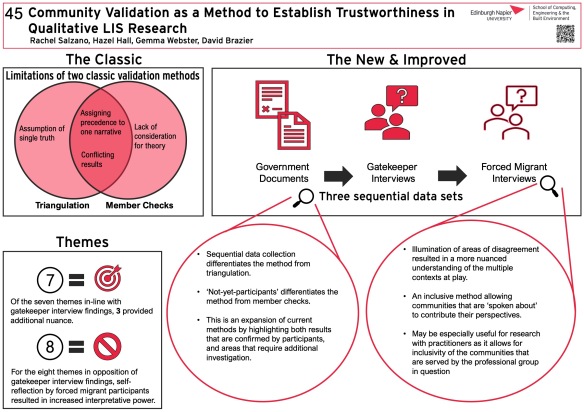
Community validation in qualitative research: contribution to #asist23

ASIST 2023 poster Salzano Hall Webster Brazier

Poster by Edinburgh Napier Social Informatics Research Group colleagues presented at #ASIST23

The main programme of the 2023 Annual Meeting of the Association for Information Science and Technology opens today in London. Sadly I cannot be there in person with my (lucky) Edinburgh Napier University Social Informatics Research Group colleagues*. Continue reading