Congratulations Lyndsey Jenkins: awarded a John Campbell Trust travel bursary

Lyndsey Jenkins

Lyndsey Jenkins

Many congratulations to Centre for Social Informatics PhD student Lyndsey Jenkins on the award of a John Campbell Trust travel bursary.

Lyndsey will use the bursary later this year to support a visit to Turku, Finland, where she will gather case study data for her ESRC-funded doctoral study on workplace learning and innovative work behaviours. Professor Gunilla Widén, and other members of the Information Studies group at Åbo Akademi University, will host Lyndsey’s visit. Lyndsey also intends to deliver a seminar presentation on her study while she is with Gunilla’s team.

The John Campbell Trust was established as an independent charitable trust through the bequest of the late Dr John Campbell. Campbell was an early member of the Institute of Information Scientists. The trust is administered by a body of Trustees under the chairmanship of Professor Adrienne Muir (Robert Gordon University). The purpose of the Trust is to further the education and development of information professionals through grants, scholarships, research or travel awards, to enhance the knowledge and experience of the information community as a whole.

Skills in sight: how social media affordances increase network awareness #ECKM2017

Iris Buunk

Presenter Iris Buunk

The 18th European Conference on Knowledge Management (#ECKM2017) takes place this year in Barcelona at the Universitat Internacional de Catalunya (UIC) on 7th and 8th September. ECKM is the longest running academic conference on knowledge management in Europe, attended by academics and practitioners from 40+ countries eager to engage in the packed conference programme.

With my colleagues Iris Buunk and Dr Colin F Smith, I am co-author of one of the papers to be presented at the conference: ‘Skills in sight: how social media affordances increase network awareness’. Continue reading

Looking forward to i3 and iDocQ 2017 #i3rgu #iDocQ2017

i3 logoEvery other year the Information: interactions and impact (i3) conference brings an international community of academic and practitioner researchers together in Aberdeen to explore the quality and effectiveness of the interactions between people and information, and how such interactions can bring about change. In the years in which it takes place, i3 is one of the highlights of the conference season. (For a flavour of the event please see my review from two years ago, and the others to which I link in my 2015 post.) Continue reading

A copy-writing role with Information Research for Lyndsey Jenkins

Information Research logoCongratulations to Centre for Social Informatics PhD student Lyndsey Jenkins, newly appointed to the team of copy-editors (or ‘editorial associates’) for Information Research. Continue reading

Registrations open for free symposium on Everyday Life Information Seeking, and information behaviours in online environments, Edinburgh, Thursday 22 June 2017 #ELIS #CPCINapier

CPCI bannerInformation science researchers with interests in Everyday Life Information Seeking, and information behaviours in online environments, are invited to register for a research symposium to be held in Edinburgh on Thursday 22 June 2017. Registration is free to all (whether established academics, early career researchers or PhD students), with a number of travel bursaries available to support the participation of PhD students (please see below). Continue reading

Knowledge sharing and networking behaviours in job search: two new papers in the latest issue of Information Research

Information Research headerThe latest issue of  Information Research published this week includes two papers that draw on research from the Centre for Social Informatics. I was a co-author on both:

Buunk, I., Hall, H., & Smith, C.F. (2017). Tacit knowledge sharing: the determination of a methodological approach to explore the intangible. Information Research, 22(1).

Mowbray, J., Hall, H., Raeside, R., Robertson, P. (2017). The role of networking and social media tools during job search: an information behaviour perspective. Information Research, 22(1). Continue reading

Love your PhD #PhDates

#PhDate logoDo (did/would) you love your PhD? Last week a number of Edinburgh Napier University PhD students celebrated Valentine’s Day by explaining why they are passionate about their doctoral research. Amongst them was one of the students that I supervise: John Mowbray. Continue reading

What does it mean to be a dangerous woman? The case of the young widow

IASH logoOver the past ten months or so I have followed with interest the Dangerous Women Project. This is one-year initiative of the Institute for Advanced Studies in the Humanities at the University of Edinburgh, led by Professor Jo Shaw. It was launched on International Women’s Day 2016 and will end on International Women’s Day 2017 on Wednesday 8th March with a closing event (free, ticketed) at the Scottish Storytelling Centre. Continue reading

Applications invited for ESRC Scottish Graduate School of Social Science Doctoral Training Partnership studentship competition 2017

Esrc_logoThe Science, Technology, Innovation, Information and Communication Studies pathway of the ESRC Scottish Graduate School of Social Science Doctoral Training Partnership (SGSSS-DTP) is currently inviting applications for this year’s studentship competition.

Academic staff at each of the pathway member institutions – including those within my group at Edinburgh Napier University – would be pleased to hear from eligible candidates who would like to apply for a PhD place under this scheme. Continue reading

How long does it take to write a PhD thesis?

My short answer is 68 days, but please read the detail below…

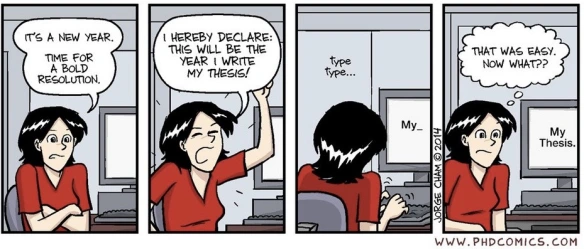
Bold resolutions PhD comic

Bold resolutions: “Piled Higher and Deeper” by Jorge Cham www.phdcomics.com

As a PhD supervisor I have often been asked ‘How long do you think it will take me to write up my thesis?’ My answer always begins ‘It depends…’ We then continue the conversation with an audit of material already drafted that may contribute (in edited format) to the final thesis. These include the initial literature review from the first year transfer report, and posters, conference papers and journal articles presented and/or published from the on-going work. Continue reading