
A decade of Dangerous Women: celebrating International Women’s Day 2026

A Decade of Dangerous WomenMarch 8th 2026 marks a decade since staff in the Institute for Advanced Studies in the Humanities (IASH) at the University of Edinburgh posted the first entry to the Dangerous Women Project web site on International Women’s Day 2016. In the year that followed, over 350 provocation pieces were added to the site in a bid to answer the question What does it mean to be a ‘dangerous woman’?

Amongst these contributions was my own on environmental scientist and Scottish aid worker Dr Linda Norgrove, who was kidnapped by the Taliban in Afghanistan on 26th September 2010 and died just a few days later in a failed rescue attempt on 8th October 2010. I also helped Dr Frances Ryan – one of my PhD students at the time, now a lecturer at Edinburgh Napier University – write for the project on dangerous young widows.

Since its official end in March 2017, the Dangerous Women Project has enjoyed a busy afterlife, for example in the publication of three books: (1) The art of being dangerous: exploring women and danger through creative expression, (2) Dangerous women: fifty reflections on women, power and identity and Women who dared: from the infamous to the forgotten. The project’s enduring relevance is also evident in its use as a teaching resource.

Given my on-going interest in the project, I was delighted to attend a lunchtime seminar entitled A decade of dangerous women at IASH last Friday 6th March 2026. Here, following an enthusiastic introduction by Professor Jo Shaw, a new cohort of researchers delivered seven minute presentations on dangerous women from the past and present. The speakers and their topics were:

  • Dr Elsie C. Albis on (predominantly female) Filipino shamans known as balinana or babaylan. Regarded by their communities as healers, leaders, keepers of memory, visionaries, and priestesses, they terrified Spanish colonialists.
  • Dr Kate Ash-Irisarri on Isabel, Countess of Buchan (C14th-C15th), whose role in the Wars of Scottish Independence has often been recast as a medieval sex scandal centred on a lustful woman, or otherwise ignored/eradicated in the record.
  • Dr Anna Girling on Nancy Cunard (1896-1965), whose work as a writer and political activist was often overshadowed by interest in her aristocratic background, social life, flamboyant fashionable sense, and string of sexual partners.
  • Dr Helen Shutt on Chief Funmilayo Ransome-Kuti (1900-1978), a Nigerian educator and political activist who campaigned successfully for women’s rights, leaving an important legacy that continues to wield a strong influence on women’s rights movements today.
  • Dr Georgi Gill on Anna Burns (1962-), a Northern Irish novelist and 2018 Man Booker prize winner whose work considers politics, society and gender in explorations of what it meant to be a woman during the ‘Troubles’.
  • Dr Jéssica Hipolito on Marielle Franco (1979-2018), a Black, LGBT Brazilian sociologist, human rights activist, and politician, who campaigned against police violence, racism, and gender inequality. Following her assassination in 2018, she is a global symbol of resistance to authoritarianism and state violence.
  • Dr Sheelalipi Sahana on Gulfisha Fatima (1993-), a student activist imprisoned for five years for an alleged role in protests against the India’s Citizenship (Amendment) Act, her ‘political dissent’ costing her the five years of her life that she had dreamt of dedicating to doctoral studies.

All the presenters spoke with passion. Georgi, a self-confessed Anna Burns fan-girl, for example, enthusiastically encouraged audience members to read her subject’s work. They also brought humour into their short talks. In Kate’s case, this was through the use of an LNER poster (below). There was also an element of performance in the presentations, for example when Sheelalipi read out some of Gulfisha Fatima’s poetry.

Despite the constraints of the seven minute slots, all the speakers made a strong case for those profiled to be considered ‘dangerous women’. Thanks are due to all who presented, and to the team that organised this celebration of International Women’s Day 2026, highlighting the long-term legacy of the Dangerous Women Project.
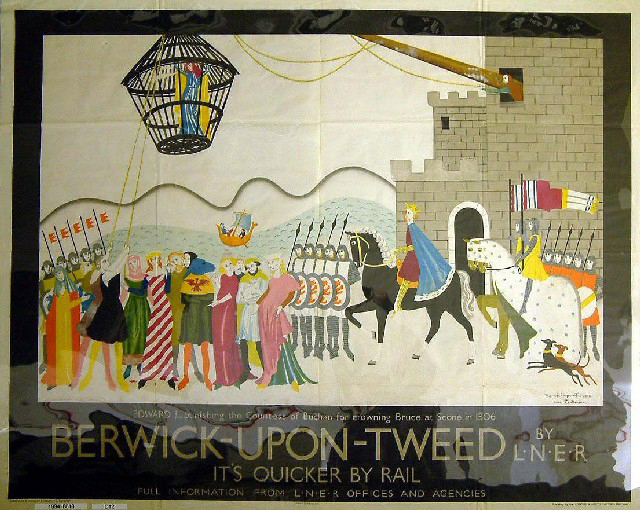
On the order of Edward I of England, Isabel Countess of Buchan was imprisoned in a cage for four years in Berwick-upon-Tweed. Poster artist: Doris Clare Zinkeisen (1898-1991). Source: the Science Museum Collection. Image released under a CC BY-NC-SA 4.0 Licence

All change for Dr Bruce Ryan

Dr Bruce Ryan

Dr Bruce Ryan

After 13 years at Edinburgh Napier University, Dr Bruce Ryan’s role as Senior Research Fellow has come to an end. Last Friday, I joined Bruce for a special meal to mark his last day in paid employment at the University. Amongst the other guests were our (former) colleagues Dr Peter Cruickshank, Dr David Haynes, and Dr Rachel Salzano.

I worked closely with Bruce for over a decade when we were colleagues in the Centre for Social Informatics. Of the many projects on which we collaborated, three stand out: Continue reading

What can you do with a PhD? Ten answers from graduates who completed their doctoral studies between 2015 and 2023

One of the questions most often asked of doctoral students is What are you going to do when you finish your PhD? For some students it is also one of the most dreaded, especially when it comes from family members or friends who barely understand the title of the doctoral research in question. An obvious, and truthful, answer is ‘No longer work on my thesis’. However, this isn’t really a suitable response. The questioner is interested in hearing about ‘proper’ job ambitions, and the value of these to a successful future career. Continue reading

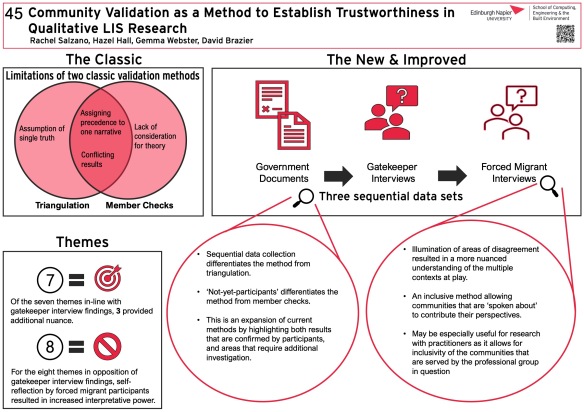
Community validation in qualitative research: contribution to #asist23

ASIST 2023 poster Salzano Hall Webster Brazier

Poster by Edinburgh Napier Social Informatics Research Group colleagues presented at #ASIST23

The main programme of the 2023 Annual Meeting of the Association for Information Science and Technology opens today in London. Sadly I cannot be there in person with my (lucky) Edinburgh Napier University Social Informatics Research Group colleagues*. Continue reading

An afternoon of Social Informatics lightning talks

Hazel Hall, Brian Detlor

Professors Brian Detlor & Hazel Hall

Dr Brian Detlor, Visiting Professor to the Social Informatics Research Group at Edinburgh Napier University, has been in the Edinburgh for the past week. Last Friday I was pleased to participate in one of the events organised to mark Brian’s visit: a lightening talk showcase of some the excellent research undertaken by researchers in the Social Informatics Research Group.

My own presentation was about the AHRC/Creative Informatics funded Platform to Platform project that I completed last year with Dr Bruce Ryan (PI) and Dr Iain McGregor (Co-I). This work involved the creation of a podcast series based on Lorna Lloyd’s Diary of the war, and an assessment audience engagement with archives in two different digital formats – (1) a Blipfoto journal of text and images, and (2) sound in podcast episodes. The slides for my presentation are available on SlideShare. Continue reading

New roles for Social Informatics PhD graduates Buunk, Middleton, Mowbray, and Ryan

What can you do with a PhD from the Centre for Social Informatics at Edinburgh Napier University? Find out here with news of four former PhD students who graduated between 2018 and 2020. Continue reading

Centre for Social Informatics ‘all centre’ meeting June 2022

Social Informatics Research Group Edinburgh Napier University selfie

Dr Peter Cruickshank, Dr David Brazier, Dr David Haynes, Dr Hazel Hall, Katherine Stephen, Dr Bruce Ryan, and Dr JP Vargheese pose for a post-meeting selfie

For the first time since 18th December 2019, this week members of my research group gathered for an end of year ‘all centre’ meeting to celebrate our recent research highlights.

Although not everyone could make it on this occasion, those who could enjoyed spending the afternoon of Wednesday 22nd June together. We took it in turns to deliver short personal updates to the rest of the group on our own research. We also read out details sent to us by email from those who could not participate in person, and gave each absent colleague a round of applause. Continue reading

Applications open for 10 fully-funded PhD studentship places within the School of Computing, Edinburgh Napier University

PhD supervisors Dr Frances Ryan, Dr David Haynes, Debbie Meharg, Dr David Brazier

PhD supervisors from the Centre for Social Informatics

The School of Computing at Edinburgh Napier University is currently advertising ten fully-funded PhD studentships across a wide range of subjects, from sound technologies to cybersecurity. Amongst these are four proposed by Centre for Social Informatics colleagues: Continue reading

Discussing dangerous women on International Women’s Day

Dangerous women project bookThis evening, on International Women’s Day 2022, I will be attending the online book launch of Dangerous women. Edited by Jo Shaw, Ben Fletcher-Watson and Abrisham Ahmadzadeh, the book comprises fifty essays on social and political structures, everyday life, attitudes, and identity to question what it means for a woman to be considered ‘dangerous’, as well the danger that a woman may present to others. I am looking forward to listening to the speakers at the launch. They include Mab Jones, Sujana Crawford, Laura Waddell, Glynis Ridley, and Rachel McCrum.

The perspectives in the book are drawn from a larger body of contributions to the Dangerous Women Project, which ran between International Women’s Day 2016 (I blogged a review of the launch event) and 2017. Continue reading

Four new projects for the Centre for Social Informatics

Social informatics research group blog headerCongratulations to Centre for Social Informatics colleagues Dr Peter Cruickshank, Dr David Haynes, Dr Bruce Ryan, and Dr Frances Ryan on securing internal Edinburgh Napier University funding for four new research projects. Continue reading