Social media by proxy: a Carnegie Research Incentive Grant for Dr Gemma Webster

Dr Gemma Webster

Dr Gemma Webster

Congratulations to my Centre for Social Informatics colleague Dr Gemma Webster, who has recently been awarded a Carnegie Research Incentive Grant (RIG). Such grants are offered to make it possible for Early Career Researchers like Gemma to undertake a short project as a Principal Investigator.

Gemma‘s application for funding is one of 59 that were successful from a total of 131 submissions in the last RIG application round (as noted in the Carnegie Trust’s analysis of RIG outcomes for the March 2018 deadline).

Gemma‘s project is entitled ‘Social media by proxy: strategies for managing the online profiles of adults with dementia’. Continue reading

Practices of community representatives in exploiting information channels for citizen democratic engagement: paper available on OnlineFirst

File:Journal of Librarianship and Information Science.jpgThe first of the seven articles that I recently co-authored for the Journal of Librarianship and Information Science (JoLIS) has now been published as an OnlineFirst paper, with the option to download it as a PDF.

In the paper entitled ‘Practices of community representatives in exploiting information channels for citizen democratic engagement‘ my co-authors Peter Cruickshank and Bruce Ryan and I explore how elected (yet unpaid) community councillors in Scotland exploit information channels for democratic engagement with the citizens that they represent. Continue reading

Applications invited for fully-funded PhD studentship on workplace skills development within the Centre for Social Informatics at Edinburgh Napier University

ESRC-SDS-Napier studentship logos

We are currently advertising a fully-funded PhD studentship within the Centre for Social Informatics at Edinburgh Napier University. (See the advertisement on FindAPhD.com and the studentship details on the Edinburgh Napier University careers pages.)

The title of the doctoral study is Meta-skills maturity for future workplaces.  

  • Applications are due by Friday 30th March 2018.
  • Interviews are scheduled for Wednesday 18th April 2018.
  • The studentship will start on Thursday 1st October 2018.

Continue reading

The impact of UKRC networking grants: a new publication on the long-term sustainability of the AHRC-funded DREaM network

DREaM again bannerAmongst the various funding schemes offered, the UK research councils support the development of research communities through schemes such as AHRC networking and EPSRC Digital Economy Network Plus grants. While it is possible to learn about the activities of these networks during their period of funding by reviewing their details on the Gateway to research, it is a more difficult task to discover their long-term impact.

This blog post concerns a new publication that addresses the question of network sustainability within a community of library and information science (LIS) researchers and practitioner researchers. Continue reading

Diversity and equality in libraries: as services, as workplaces

In general, libraries are considered as inclusive institutions, where all users expect to receive the same level of service regardless of personal characteristics such as age, gender, marital status, race, religion, sexual orientation or social class.

Continue reading

Information Literacy for Democratic Engagement (IL-DEM) project: findings

Information Literacy group logoPeter Cruickshank, Dr Bruce Ryan and I recently completed the Information Literacy for Democratic Engagement (IL-DEM) project. This work set out to investigate levels of digital and information literacy within Scotland’s Community Council system. It was supported by a grant from the CILIP Information Literacy Group.

We explored how community councillors develop the skills required to inform and engage with the citizens that they represent, and how libraries support this work. In doing so have extended further two established research streams within the Centre for Social Informatics: (1) Cruickshank and Ryan’s work on digital engagement in local democracy (such as our DigiCC workshops), and (2) mine with Christine Irving on information literacy and life-long learning. This work also builds upon our group’s track record in library and information science research. Continue reading

Information Literacy for Democratic Engagement: project update #IL-DEM

Information Literacy group logoThe Centre for Social Informatics is currently undertaking a project entitled Information Literacy for Democratic Engagement (IL-DEM).  Supported by a grant from the CILIP Information Literacy Group, our work investigates levels of digital and information literacy within Scotland’s Community Council system.

Specifically Peter Cruickshank, Dr Bruce Ryan and I are exploring how community councillors develop the skills required to inform and engage with the citizens that they represent, and how libraries support this work. In doing so we’re extending two established research streams within the Centre for Social Informatics: Cruickshank and Ryan’s work on digital engagement in local democracy (such as our DigiCC workshops), and mine with Christine Irving on information literacy and life-long learning. This work also builds upon our group’s track record in library and information science research. Continue reading

Research impact from LISResearch.org to LISResearch.org.au #LISRAproject

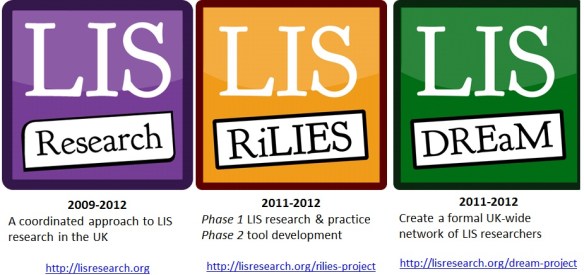
LIS Research Coalition DREaM RiLIES logosBetween 2009 and 2012 I led the implementation of the UK’s Library and Information Science Research Coalition. The broad mission of the Coalition was to facilitate a coordinated and strategic approach to Library and Information Science (LIS) research across the UK, strengthening links between LIS researchers and LIS practitioners, and between research and practice. This was achieved through the activities of the Coalition as a whole, and its ‘daughter’ projects: Developing Research Excellence and Methods (DREaM), and the two-part Research in Librarianship Impact Evaluation Study. Continue reading

Who is the ‘typical’ UK information worker? Headline findings of the CILIP/ARA Workforce Mapping Project

Workforce Mapping Project executive summary

The executive summary is available from the CILIP web site

Last week the Chartered Institute of Library and Information Professionals (CILIP) and the Archives and Records Association (ARA) held a launch event in London. Here an executive summary of the Workforce Mapping Project, with which I have been heavily involved over the past 15 months, was presented. The summary distributed at the launch notes key findings of the study.

These include:

  • The estimated size of the UK workforce in the Library, Archives, Records, Information Management, and Knowledge Management professions is 86,376.
  • Women dominate the workforce (78.1% of the workforce is female, and 21.9% male), yet earn less than men, and are not so well represented in senior management positions.
  • The workforce is highly qualified: 61.4% hold postgraduate academic qualifications.
  • The workforce is ageing: 55.3% of its members are over 45 years of age. (The equivalent figure for the UK workforce as a whole is 41.1%.)
  • There is low ethnic diversity in the workforce: 96.7% identify as ‘white’.

Continue reading